Light in the Darkness Fasting and Prayer – Week Two

This Sunday, we continued our annual Light in the Darkness season. This is our name for the historical practice of Advent, when our days get darker just as we are preparing for Christmas. It’s an opportunity to come to terms with the days of declining sunlight and the impending winter, as well as our own limits and struggles and hunger and need. At the same time, it’s a season to celebrate the light of Jesus with us and to hope for more of Jesus, and more light and joy and life and peace in our present and our future.

One way that followers of Jesus over the centuries have waited and hoped during this season has been through fasting and prayer. Consider taking one day, or even one meal, a week from now through Christmas – it’s just two weeks away! – to skip your food and to reflect and pray instead. It’s a way of acknowledging our hunger and need for God and for letting our bodies and minds stop and pay attention.

Whether you fast or not, here’s a way you can pray for Reservoir Church and for your world this week.

For our church: This week, a few of us will interview several candidates for our Director of Worship and Arts. We’ve looked for musicians who can lead worship – drawing from historical and contemporary and gospel traditions, support artists and arts programming, and develop and promote other leaders. Pray for that we find and hire someone who will help our bands and congregation experience God together, while promoting a flourishing of the arts and creativity and beauty both at Reservoir and in our city more broadly.

For our world: In times of tension and injustice and insecurity, the arts can provoke questions, challenge the status quo, and stir us to hope and wonder. The arts can also evoke wonder, stirring us toward faith and hope in God and a deeper and truer humanity. Pray for all that visual and performing artists in our Reservoir community, that God provides for them and sustains their work. Pray for our city and world more broadly, that God would raise up the artists our times need and help us all to stop and pay attention. Pray that our city and our earth would be full of worship and wonder in this Christmas season.

Light in the Darkness Fasting and Prayer – Week One

This Sunday, we began our annual Light in the Darkness season. This is our name for the historical practice of Advent, when our days get darker just as we are preparing for Christmas. It’s an opportunity to come to terms with the days of declining sunlight and the impending winter, as well as our own limits and struggles and hunger and need. At the same time, it’s a season to celebrate the light of Jesus with us and to hope for more of Jesus, and more light and joy and life and peace in our present and our future.

This past Sunday, at Reservoir, we listened to the Christmas story told in five parts. An actor in our community, Holly Schaff, told us the story of the prophets, the holy family, the shepherds, the magi, and the light of Christ, using the Godly Play curriculum we use in our kids’ church programming. We also considered what it means for us to find ourselves in this story, to stop and pay attention, to be weary and to wait, to find less fear and more joy, and to hope.

One way that followers of Jesus over the centuries have waited and hoped during this season has been through fasting and prayer. Consider taking one day, or even one meal, a week from now through Christmas – it’s just three weeks! – to skip your food and to reflect and pray instead. It’s a way of acknowledging our hunger and need for God and for letting our bodies and minds stop and pay attention.

Whether you fast or not, here’s a way you can pray for Reservoir Church and for your world this week.

For our church: This January, Lydia Shiu will join us as a new pastor – helping new people integrate into the life of the church as members, community organizing, coming alongside people in our community with conversation and love and prayer, and doing all the other things a pastor does. She and her new husband Eugene are moving across the country to join us, after a fall of travels in East Asia and for Eugene, a temporary work assignment in Singapore. Pray for God’s peace and help for them in their move and in their acclimation to a new city, in the middle of a Boston winter! Pray for great housing, great friends, a great welcome from Reservoir, and for years of fruitful ministry in our city for Lydia.

For our world: Our city and cities throughout the world are full of young adults asking powerful existential questions about meaning and mattering and relationships in their lives. And many are finding that their family systems and careers and religious traditions aren’t addressing these questions as powerfully as sometimes other generations felt they did. Pray for spiritual homes, for pastoral care and guidance, and for courage and love and wisdom for our current and future young adults as they make their way in the world.

“For a child has been born for us,
    a son given to us;
authority rests upon his shoulders;
    and he is named
Wonderful Counselor, Mighty God,
    Everlasting Father, Prince of Peace.”

Isaiah 9:6

Daily Readings in John – Day Forty-Three

John 12:36b-50 (NRSV)

After Jesus had said this, he departed and hid from them. 37 Although he had performed so many signs in their presence, they did not believe in him. 38 This was to fulfill the word spoken by the prophet Isaiah:

“Lord, who has believed our message,
    and to whom has the arm of the Lord been revealed?”

39 And so they could not believe, because Isaiah also said,

40 “He has blinded their eyes
    and hardened their heart,
so that they might not look with their eyes,
    and understand with their heart and turn—
    and I would heal them.”

41 Isaiah said this because he saw his glory and spoke about him. 42 Nevertheless many, even of the authorities, believed in him. But because of the Pharisees they did not confess it, for fear that they would be put out of the synagogue; 43 for they loved human glory more than the glory that comes from God.

44 Then Jesus cried aloud: “Whoever believes in me believes not in me but in him who sent me. 45 And whoever sees me sees him who sent me. 46 I have come as light into the world, so that everyone who believes in me should not remain in the darkness. 47 I do not judge anyone who hears my words and does not keep them, for I came not to judge the world, but to save the world. 48 The one who rejects me and does not receive my word has a judge; on the last day the word that I have spoken will serve as judge, 49 for I have not spoken on my own, but the Father who sent me has himself given me a commandment about what to say and what to speak. 50 And I know that his commandment is eternal life. What I speak, therefore, I speak just as the Father has told me.”

John collects some thoughts and some quotations from Jesus and wraps up the first half of his book with a huge flourish of a coda. So many of the themes are here – God as source of life and eternal life, those who believe and those who don’t believe, Jesus as the light sent from God so we can see God and see ourselves and see everything clearly, Jesus saving instead of judging even though he could do either if he chose, and the nature and source of glory.

All those big things are here, in a short set of verses at the end of John’s Book of Signs. John 13 takes us into the second half of the book, which focuses on Jesus’ last words and actions with his apprentices, his suffering and death, and scenes from the first days of his resurrection.


Read ahead if you like, but the blogging will come to a pause for now. I’m going to post a weekly reflection and invitation to fasting and prayer during our Advent season we call Light in the Darkness. And then in mid-February, 2018, we’ll start out annual 40 Days of Faith before Easter, which will include a set of daily readings in the so deep, so crazy final book of the Bible called Revelation.

See you around the blog!

Meanwhile, a final thought from John, well more from me, on the signs.

Almost five years ago, our family of five drove from Boston to Florida. During the second of two 12-hour days of driving, we saw sign after sign after sign – dozens and dozens of them – for this roadside attraction called South of the Border. One article describes the place this way: “If Las Vegas hooked up with Route 66 and had a baby, this would be it.” Sounds about right.

It’s bad Mexican food meets dollar store meets racial stereotypes meet roadside kitsch. We pulled over for a few minutes and then kept on going. We followed the signs to where they were going, but the destination disappointed. No glory.

As Jesus briefly goes into hiding, a few weeks before the explosive final final week before his crucifixion, John says the reverse has happened. There were so many signs – John has told us about several – that Jesus is from God, that Jesus shines the light of God, that Jesus connects us with God’s wonders, what John calls John’s glory.

But following those signs to where they lead takes a new way of seeing, different from our usual blindness to what’s most important. Following the signs takes open and courageous hearts. Following the signs might even take setting aside “our own glory” – our own reputation and narrow self-obsession.

Many people don’t follow the signs to the end, don’t take the exit and “come and see” for ourselves what’s there.

If John could write a little coda just to us, I think he’d urge us to keep looking at the signs he told us about, keep listening to the words that Jesus said, and go where they lead. Because there we’ll find God, there we’ll find glory.

Daily Readings in John – Day Forty-Two

John 12:20-36a (NRSV)

20 Now among those who went up to worship at the festival were some Greeks. 21 They came to Philip, who was from Bethsaida in Galilee, and said to him, “Sir, we wish to see Jesus.” 22 Philip went and told Andrew; then Andrew and Philip went and told Jesus. 23 Jesus answered them, “The hour has come for the Son of Man to be glorified. 24 Very truly, I tell you, unless a grain of wheat falls into the earth and dies, it remains just a single grain; but if it dies, it bears much fruit. 25 Those who love their life lose it, and those who hate their life in this world will keep it for eternal life. 26 Whoever serves me must follow me, and where I am, there will my servant be also. Whoever serves me, the Father will honor.

27 “Now my soul is troubled. And what should I say—‘Father, save me from this hour’? No, it is for this reason that I have come to this hour. 28 Father, glorify your name.” Then a voice came from heaven, “I have glorified it, and I will glorify it again.” 29 The crowd standing there heard it and said that it was thunder. Others said, “An angel has spoken to him.” 30 Jesus answered, “This voice has come for your sake, not for mine. 31 Now is the judgment of this world; now the ruler of this world will be driven out. 32 And I, when I am lifted up from the earth, will draw all people to myself.” 33 He said this to indicate the kind of death he was to die. 34 The crowd answered him, “We have heard from the law that the Messiah remains forever. How can you say that the Son of Man must be lifted up? Who is this Son of Man?” 35 Jesus said to them, “The light is with you for a little longer. Walk while you have the light, so that the darkness may not overtake you. If you walk in the darkness, you do not know where you are going. 36 While you have the light, believe in the light, so that you may become children of light.”

Today, something different from me – a letter to Jesus. Do with it what you will.

(a) Eavesdrop, and pray. (b) Write your own letter. (c) Do something entirely different. (d) None of the above. (e) All of the above.

Jesus, your soul was troubled as you prepared for what might be the end. You watched the dying of the light at sunset, and I’m imagining that in that way that flashes of divine insight – just knowing everything you had no cause to know – may have overcome you. Seeing all the things that happen at night. Perhaps you heard children’s shattering teeth at they trembled in their nightmares of monsters and falls and loneliness. Perhaps you saw the preparation of thieves or the drunken man arriving home to beat his wife before sleeping by her side. Perhaps you smelled the weariness of the old and injured and disabled in their beds.

And this time you let yourself think of yourself as well, of the impending dying of your light. Your compassion and your power, your breath and your consciousness ceasing, and soon. You hoped, you believed this was necessary, and this was the seed’s death that yields great harvest. You’d be lifted up, all people would be drawn, life would return. But could you have known?

I too hate death and dying in all its many forms. I’m a little bit afraid if I let myself stop and think about my elder friends and family, the sick ones too, and wonder how much time they have left. I have this pain in my side today after moving chairs – it will be gone soon, but it never would have happened ten years ago, maybe even not last year or last week. I’m getting older too.

And then I think about the things that ask for my grief, waiting to be remembered in tears. And I imagine the choices I’ve made and the ones that must be made that will shrink my choices, abandon my rights, lessen my options and my pleasures – they will be for the good if I have the courage for completion, but they will each be their own small seed-like death.

Can I trust you today, Jesus, that all life comes from dying seeds? Buried in the ground to decay before their transformation and mixing with soil and light and water and all the other stuff of the earth, they will rise and bear fruit. Could this be true of me and all that I hold dear?

I hope that it is so, because as much as anything else, I too wish to see Jesus, and to be with you Jesus in your dying and rebirth, in your humble place covered in dirt, and in your sprouting up and shooting off leaves and fruit.

May it be so.

Daily Readings in John – Day Forty-One

John 12:9-19 (NRSV)

When the great crowd of the Jews learned that he was there, they came not only because of Jesus but also to see Lazarus, whom he had raised from the dead. 10 So the chief priests planned to put Lazarus to death as well, 11 since it was on account of him that many of the Jews were deserting and were believing in Jesus.

12 The next day the great crowd that had come to the festival heard that Jesus was coming to Jerusalem. 13 So they took branches of palm trees and went out to meet him, shouting,

“Hosanna!
Blessed is the one who comes in the name of the Lord—
    the King of Israel!”

14 Jesus found a young donkey and sat on it; as it is written:

15 “Do not be afraid, daughter of Zion.
Look, your king is coming,
    sitting on a donkey’s colt!”

16 His disciples did not understand these things at first; but when Jesus was glorified, then they remembered that these things had been written of him and had been done to him. 17 So the crowd that had been with him when he called Lazarus out of the tomb and raised him from the dead continued to testify. 18 It was also because they heard that he had performed this sign that the crowd went to meet him. 19 The Pharisees then said to one another, “You see, you can do nothing. Look, the world has gone after him!”

There’s so much in this passage, that I don’t know where to start commenting or where to focus. There’s the utter meanness, the cold political calculus of the plot against Jesus extending to Lazurus as well.

By contrast, there’s the jubilant celebration of the crowds as Jesus rides into Jerusalem on a donkey. John has Jesus in and out of Jerusalem throughout the book of signs (first half/first twelve chapters of his memoirs), but usually arriving in secret. This time, it’s public. This time, there’s a symbolic gesture associated with messianic prophecy. This time, the crowds are shouting a Hebrew word of praise – Hosanna – he saves!

And then there’s John’s quiet reflection at the end. Crowds are testifying – something true and important is being noticed. Closest apprentices are confused. Cultural and religious elites are befuddled. Truth, confusion, chaos…

Let’s try lectio divina – divine reading – again. Read the passage once, asking what words or phrases stick out to you. Read it a second time, asking what those words or phrases mean to you. And read it a third time, asking if you’re compelled to do anything.

Peace to you today.

We’re nearing the end of the Book of Signs and the end of this blogging for now. Two more days.

Daily Readings in John – Day Forty

John 12:1-8 (NRSV)

12 Six days before the Passover Jesus came to Bethany, the home of Lazarus, whom he had raised from the dead. There they gave a dinner for him. Martha served, and Lazarus was one of those at the table with him. Mary took a pound of costly perfume made of pure nard, anointed Jesus’ feet, and wiped them with her hair. The house was filled with the fragrance of the perfume. But Judas Iscariot, one of his disciples (the one who was about to betray him), said, “Why was this perfume not sold for three hundred denarii and the money given to the poor?” (He said this not because he cared about the poor, but because he was a thief; he kept the common purse and used to steal what was put into it.) Jesus said, “Leave her alone. She bought it so that she might keep it for the day of my burial. You always have the poor with you, but you do not always have me.”

One of the hallmarks of the Jesuit spiritual tradition, called Igantian spirituality after their founder Ignatius of Loyola, is imaginative reading of scripture. Let’s practice.

Imagine yourself in the one common room of a very small, old stone house. One wall has windows that open into a little courtyard. Another leads to a private sleeping room. Another has a doorway through which the host, a young woman named Martha, has come in and out with bread, humus, and some olives and vegetables. It’s a simple meal, as the family is just days away from the largest meal of the year at Passover.

Still, the friend of the family, a travelling teacher named Jesus is here, as the guest of honor. The room is crowded, as his apprentices are with him, as is the host family and some other friends. The young man of the family, Lazurus, isn’t eating much. In fact, he can’t stop staring at Jesus; his mouth hangs open a little, even when he’s not talking. Rumor has it he was wrapped in grave clothes and lying in the family tomb not too long ago, before Jesus called him out and he actually got up and walked again. Here he is, a few people to your left.

There’s no table here. Everyone is reclining on a rug, leaning on one elbow as they talk and eat. A few sit up, leaning back against the wall, bellies full.

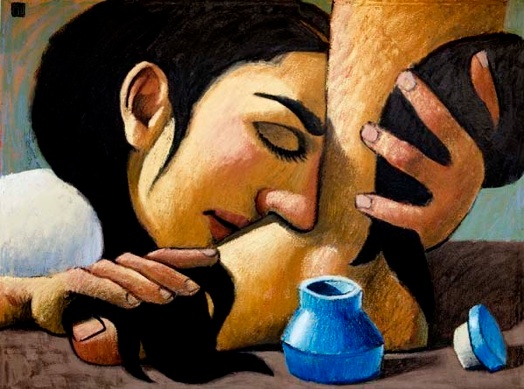
And now, Mary, sister of the host enters and pours perfume over Jesus’ feet. The smell has filled the room, its sweetness mixing with the aromas of garlic and olives and bread. Mary has no towel, but is using her own hair to rub the fragrance into Jesus’ feet, like an ointment or lotion. Jesus has the trace of a smile on his face; he looks calm, content.

The whole room is quiet, shocked. What is Mary doing? Will someone tell her to back away? It’s almost indecent. You’d do this for your lover, perhaps, or for a corpse you’re preparing for burial. Not for a guest, not for a rabbi.

The silence is interrupted, as Judas complains about the waste of it all. Ironic, as he’s wearing new, clean clothes and people say he’s a thief. But Jesus doesn’t confront him; he barely acknowledges what he’s said.

He just looks around slowly and then turns back toward Mary by his feet and says, “Let her be. This is what love looks like. She’s preparing me for my burial, which is coming soon.”

What do you see and feel? Who do you relate to? What troubles or inspires you? Do Mary or Judas or Jesus remind you of anyone you know, or anything in yourself?

Is there anything you want to say to Jesus now? If so, go ahead.

Daily Readings in John – Day Thirty-Nine

John 10:45-57 (NRSV)

45 Many of the Jews therefore, who had come with Mary and had seen what Jesus did, believed in him. 46 But some of them went to the Pharisees and told them what he had done. 47 So the chief priests and the Pharisees called a meeting of the council, and said, “What are we to do? This man is performing many signs. 48 If we let him go on like this, everyone will believe in him, and the Romans will come and destroy both our holy place and our nation.” 49 But one of them, Caiaphas, who was high priest that year, said to them, “You know nothing at all! 50 You do not understand that it is better for you to have one man die for the people than to have the whole nation destroyed.” 51 He did not say this on his own, but being high priest that year he prophesied that Jesus was about to die for the nation, 52 and not for the nation only, but to gather into one the dispersed children of God. 53 So from that day on they planned to put him to death.

54 Jesus therefore no longer walked about openly among the Jews, but went from there to a town called Ephraim in the region near the wilderness; and he remained there with the disciples.

55 Now the Passover of the Jews was near, and many went up from the country to Jerusalem before the Passover to purify themselves. 56 They were looking for Jesus and were asking one another as they stood in the temple, “What do you think? Surely he will not come to the festival, will he?” 57 Now the chief priests and the Pharisees had given orders that anyone who knew where Jesus was should let them know, so that they might arrest him.

 If John had a soundtrack, it would have just changed in mood, rhythm, meter, and tone rather abruptly. We move from the soaring glory-of-God-on-full-power raising of Lazurus from the dead, to smoky room political conspiracy, fearful rumors, plots of death, and hiding out in the wilderness.
I used to feel more judgmental or shocked about the actions of the elites in the gospel stories. The council hears rumors that Jesus has performed miracles, and all they can do is fear for their own security? Don’t they have an ounce of curiosity or wonder in them?
I guess over time I’ve taken a dimmer view of political processes and how much good happens in council and committee meetings. So often our collective group psychologies tend drift toward expression of our fears and resentments, that why should it surprise us that this Jerusalem council would be any different? They had a fearful and complex role – try to manage the Roman occupation and preserve a limited degree of civic and religious freedom, keep the hopeful and resentful masses at bay, and see if they could hold on to their own power and positions all at once.
No wonder that Jesus, who had no real interest in their concerns represented a problem. He didn’t have much sympathy for human prestige and ambition. And while he had no interest in direct confrontation with Rome, he didn’t exactly keep people’s wildest hopes in check. No, he increased them. People around him got restless and hopeful and motivated for change – they started to believe. Which may have been great for them, but not so helpful for the cause of political stability.
So the council wants him dead.
Here, though, John things that the possibility that God works for good in all things for those who love God may once again be at play. Even in Caiaphas’ Machiavellian moral calculus, God manages to turn things for good. Jesus’ death will turn for the good of the whole nation, if not in the way that the council intended. Within a generation, their city, their temple, their council will all be gone. But Jesus will have thousands of people scattered about the Eastern Roman Empire saying that he died and has risen again, and all peoples on earth – Palestinian Jews, Romans near and far, and everyone beyond has a stake and blessing and a hope in this.

Daily Readings in John – Day Thirty-Eight

John 11:38-44 (NRSV)

38 Then Jesus, again greatly disturbed, came to the tomb. It was a cave, and a stone was lying against it. 39 Jesus said, “Take away the stone.” Martha, the sister of the dead man, said to him, “Lord, already there is a stench because he has been dead four days.” 40 Jesus said to her, “Did I not tell you that if you believed, you would see the glory of God?” 41 So they took away the stone. And Jesus looked upward and said, “Father, I thank you for having heard me. 42 I knew that you always hear me, but I have said this for the sake of the crowd standing here, so that they may believe that you sent me.” 43 When he had said this, he cried with a loud voice, “Lazarus, come out!” 44 The dead man came out, his hands and feet bound with strips of cloth, and his face wrapped in a cloth. Jesus said to them, “Unbind him, and let him go.”

So from the start of the chapter, we’ve heard that this awful tragedy would be the grounds for revealing the glory of God – the beauty, the transcendent other-ness, the stunning reputation, all that is special about God that stops us in our tracks in wonder.

I think we’ve seen it already. The glory of God in Jesus’ courage to go to the region where his life is in danger, just to be with his grieving friends. The glory of God in filling Martha’s mind with insight and hope that Jesus is the promised one of God who is bringing life and hope into the world. The glory of God in Jesus’ weeping with Martha, in the deep compassion and anger of God for how things are in our world.

And here the glory of God reaches a climax. The glory of God is seen in rolling away the stone of death’s finality, in upending the closure of loss, and in calling out new life with a word from God. The glory of God is here in a dead man walking.

Even in this climax of the glory of God, there’s a place for mere mortals, though. The once grieving, now shocked funeral assembly is given a task to do. They are to unwrap Lazurus from his stench-filled graveclothes and to release him into renewed life.

God includes people as partners in just about everything God does. There is always a piece for us to do, and this too reveals the glory of God.

It might be a simple prayer, to which God responds in power. It might be a word of appreciation or gratitude or encouragement, which God uses to keep someone going. It might be an act of service, or work done faithfully in your job that God uses to provide for economic or physical needs.

Yesterday, a friend of mine took the courage to share with me an insight she had when she prayed for me. She shared it humbly, in the event it might be helpful, and it unlocked something really helpful in my mind today.

How is God at work for glory today, and what part are you invited to play in this?

Daily Readings in John – Day Thirty-Seven

John 11:28-36

28 When she had said this, she went back and called her sister Mary, and told her privately, “The Teacher is here and is calling for you.” 29 And when she heard it, she got up quickly and went to him. 30 Now Jesus had not yet come to the village, but was still at the place where Martha had met him. 31 The Jews who were with her in the house, consoling her, saw Mary get up quickly and go out. They followed her because they thought that she was going to the tomb to weep there. 32 When Mary came where Jesus was and saw him, she knelt at his feet and said to him, “Lord, if you had been here, my brother would not have died.” 33 When Jesus saw her weeping, and the Jews who came with her also weeping, he was greatly disturbed in spirit and deeply moved. 34 He said, “Where have you laid him?” They said to him, “Lord, come and see.” 35 Jesus began to weep. 36 So the Jews said, “See how he loved him!” 37 But some of them said, “Could not he who opened the eyes of the blind man have kept this man from dying?”

In our last entry, we met one sister – Martha, the practical one, the gracious one, and the theological one. Martha then gets her sister Mary, whose grief is thicker than Martha’s, it appears. On Meyers-Briggs terms, for those of you that know your personality assessments, Mary is an NF – perceiving the world more through intuition than data, and making decisions that are influenced more strongly by her feeling than her thinking. I’m an “NF” too, so I get Mary. Jesus seems to get her too. In fact, he’s unusually responsive to her.

They are close enough, or Jesus is so compassionate, that his psychological mirroring function kicks in strongly and he feels what she feels. Soon her grief becomes his, and Jesus too is weeping.

In many translations, verse 35 is just a two word sentence: Jesus wept. It’s famously the shortest verse in the Bible and maybe one of the more significant.

Cate Nelson gave a stunning sermon on this passage at Reservoir this fall, and I will simply repeat her insight in brief. Jesus weeps out of the sadness of God, that shares our pain and mourns the pain and loss of hurt and death. And Jesus weeps out of the anger of God, that sees death – in all its literal and metaphorical forms – as a violation of the good world God made and the flourishing life that God is recreating in the world.


Where is Jesus weeping with you today? Where is Jesus’ sadness or anger active that you can perceive? Try asking Jesus. What does this mean to you?

Daily Readings in John – Day Thirty-Six

John 11:17-27 (NRSV)

17 When Jesus arrived, he found that Lazarus had already been in the tomb four days. 18 Now Bethany was near Jerusalem, some two miles away, 19 and many of the Jews had come to Martha and Mary to console them about their brother. 20 When Martha heard that Jesus was coming, she went and met him, while Mary stayed at home. 21 Martha said to Jesus, “Lord, if you had been here, my brother would not have died. 22 But even now I know that God will give you whatever you ask of him.” 23 Jesus said to her, “Your brother will rise again.” 24 Martha said to him, “I know that he will rise again in the resurrection on the last day.” 25 Jesus said to her, “I am the resurrection and the life. Those who believe in me, even though they die, will live, 26 and everyone who lives and believes in me will never die. Do you believe this?” 27 She said to him, “Yes, Lord, I believe that you are the Messiah, the Son of God, the one coming into the world.”

Jesus is good friends with this family, and before he does anything else, he talks with each sister. The first is Martha, and their conversation is intellectual and theological.

Her questioning and her interactions with Jesus are a beautiful model of faith. She tells Jesus he could have stopped this bad thing, and that she knows that God will still do what Jesus asks.

When Jesus promises he will live again, she likely assumes that he means this will happen in some distant future, but she agrees with Jesus that this good news will happen.

I like Martha. She’s smart, she’s patient, and she has hope, just four days after her brother’s death, which is remarkable.

She also gives us a window into part of what this rich Hebrew word “Messiah” means. This word, which literally means “anointed”, the one marked with oil, represents “God’s chosen one” and is translated into Greek as “Christ.”

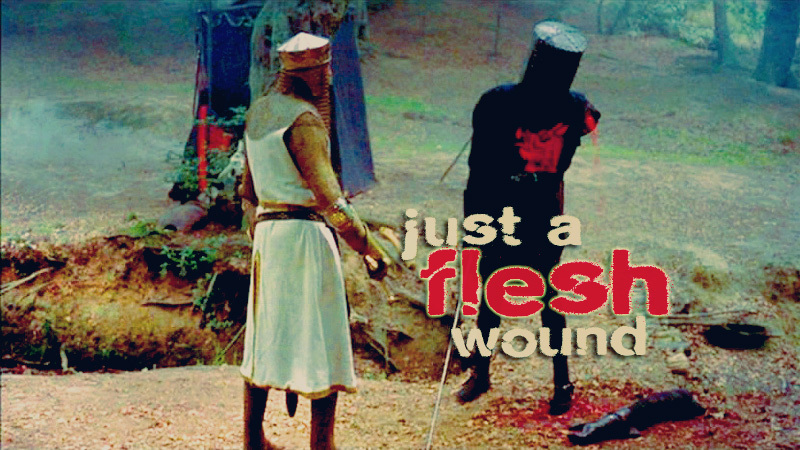
Here, Jesus and his friend Martha tell us that Messiah means that death is impermanent, that the greatest curse and fear we face doesn’t have the last say. Even death is “but a flesh wound.”