Daily Readings, Day Five

John 2:1-12 (NRSV)

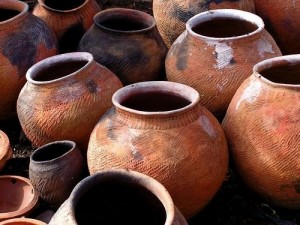
On the third day there was a wedding in Cana of Galilee, and the mother of Jesus was there. Jesus and his disciples had also been invited to the wedding. When the wine gave out, the mother of Jesus said to him, “They have no wine.” And Jesus said to her, “Woman, what concern is that to you and to me? My hour has not yet come.” His mother said to the servants, “Do whatever he tells you.” Now standing there were six stone water jars for the Jewish rites of purification, each holding twenty or thirty gallons. Jesus said to them, “Fill the jars with water.” And they filled them up to the brim. He said to them, “Now draw some out, and take it to the chief steward.” So they took it. When the steward tasted the water that had become wine, and did not know where it came from (though the servants who had drawn the water knew), the steward called the bridegroom 10 and said to him, “Everyone serves the good wine first, and then the inferior wine after the guests have become drunk. But you have kept the good wine until now.” 11 Jesus did this, the first of his signs, in Cana of Galilee, and revealed his glory; and his disciples believed in him.

12 After this he went down to Capernaum with his mother, his brothers, and his disciples; and they remained there a few days.

Once upon a time, there was a god named Dionysus. Child of a human mother and born again of a god-father, he leads a procession of mad, dancing females, followed by hungry, bearded satyrs with erect phalluses. Should life prove too violent or discouraging or merely too mundane, he represents the wine and the sex and the religious rituals that can give you a few moments of ecstasy to escape for a spell.

Into this Dinosyian world, John says there is another god-man who talks about being born again. He too it seems can be present in moments associated with fertility – in this case a wedding – and he too can make the best of wine. Jesus, though, is modest in his entry. He doesn’t thrill, but serves; in fact, he lays down his life for his friends.

The wine of Jesus also goes down smooth, without the usual day-after regret. In fact, Jesus is stirred to action to remove and prevent the shame this family would have experienced had they run out of wine at such an important family event.

And the world that Jesus inhabits isn’t mundane or ordinary in the least. In fact, this world is becoming something new entirely. This moment at the wedding is just the first signpost. More and more, with Jesus around, we will see the light and beauty and renewal that will make us say, “Glory!”

Have you run out of wine in any space in your life? What does that lack feel like? Invite Jesus to bring the very best there.

Daily Readings, Day Four

John 1:29-51 (NRSV)

29 The next day he saw Jesus coming toward him and declared, “Here is the Lamb of God who takes away the sin of the world! 30 This is he of whom I said, ‘After me comes a man who ranks ahead of me because he was before me.’ 31 I myself did not know him; but I came baptizing with water for this reason, that he might be revealed to Israel.” 32 And John testified, “I saw the Spirit descending from heaven like a dove, and it remained on him. 33 I myself did not know him, but the one who sent me to baptize with water said to me, ‘He on whom you see the Spirit descend and remain is the one who baptizes with the Holy Spirit.’ 34 And I myself have seen and have testified that this is the Son of God.”

35 The next day John again was standing with two of his disciples, 36 and as he watched Jesus walk by, he exclaimed, “Look, here is the Lamb of God!” 37 The two disciples heard him say this, and they followed Jesus. 38 When Jesus turned and saw them following, he said to them, “What are you looking for?” They said to him, “Rabbi” (which translated means Teacher), “where are you staying?” 39 He said to them, “Come and see.” They came and saw where he was staying, and they remained with him that day. It was about four o’clock in the afternoon. 40 One of the two who heard John speak and followed him was Andrew, Simon Peter’s brother. 41 He first found his brother Simon and said to him, “We have found the Messiah” (which is translated Anointed). 42 He brought Simon to Jesus, who looked at him and said, “You are Simon son of John. You are to be called Cephas” (which is translated Peter).

43 The next day Jesus decided to go to Galilee. He found Philip and said to him, “Follow me.” 44 Now Philip was from Bethsaida, the city of Andrew and Peter. 45 Philip found Nathanael and said to him, “We have found him about whom Moses in the law and also the prophets wrote, Jesus son of Joseph from Nazareth.” 46 Nathanael said to him, “Can anything good come out of Nazareth?” Philip said to him, “Come and see.” 47 When Jesus saw Nathanael coming toward him, he said of him, “Here is truly an Israelite in whom there is no deceit!” 48 Nathanael asked him, “Where did you get to know me?” Jesus answered, “I saw you under the fig tree before Philip called you.” 49 Nathanael replied, “Rabbi, you are the Son of God! You are the King of Israel!” 50 Jesus answered, “Do you believe because I told you that I saw you under the fig tree? You will see greater things than these.” 51 And he said to him, “Very truly, I tell you, you will see heaven opened and the angels of God ascending and descending upon the Son of Man.”

Jesus hits the ground in John. There’s been a formal philosophical introduction but no regular backstory. Who is this man? Where did he grow up? Where has he come from? John eschews regular biographical function and answers those questions like this. He is the Lamb of God. He grew up in the stars. He comes from God.

These three days begin with John’s highly religious, mystical introduction. There is priestly imagery – Spirit descending, baptism which has its roots in Jewish cleansing ritual, and this symbol of Lamb – which could reference the temple sacrifices, the scapegoat that takes blame into the wilderness, or the Passover meal.

And the days end with a nod to an ancient story from these men’s cultural and religious founding fathers. Before Jacob knew God for himself, he had a dream, and in that dream there was a ladder to heaven, and Jacob woke up and said, “God is here and I didn’t know it.”

God is here, and I didn’t know it.

That’s more or less what is happening all around Jesus, as people walk around with him, listen to his little cryptic stories and comments, and come and see what he’s about for himself.

God is here, and I didn’t know it.

Ask Jesus, if you like, to help you come and see today where God is in or around you.

Daily Readings, Day 3

John 1:19-28 (NRSV)

19 This is the testimony given by John when the Jews sent priests and Levites from Jerusalem to ask him, “Who are you?” 20 He confessed and did not deny it, but confessed, “I am not the Messiah.” 21 And they asked him, “What then? Are you Elijah?” He said, “I am not.” “Are you the prophet?” He answered, “No.” 22 Then they said to him, “Who are you? Let us have an answer for those who sent us. What do you say about yourself?” 23 He said,

“I am the voice of one crying out in the wilderness,
‘Make straight the way of the Lord,’”

as the prophet Isaiah said.

24 Now they had been sent from the Pharisees. 25 They asked him, “Why then are you baptizing if you are neither the Messiah, nor Elijah, nor the prophet?” 26 John answered them, “I baptize with water. Among you stands one whom you do not know, 27 the one who is coming after me; I am not worthy to untie the thong of his sandal.” 28 This took place in Bethany across the Jordan where John was baptizing.

Today, we go for a minute from the sublime to the arcane. From mystical poetry on God-with-us new creation to an old argument about names and John.

All the names here – Isaiah, Elijah, Messiah, Pharisees, John, priests, Levites, Bethany, and the Jordan River. We’re in a real time and place that is really far from us. And we’re watching a set of real arguments play out. I’ll write more another day about this unfortunate phrase “The Jews” in John. Later, it will be one of many things that makes it easier for Christians to be anti-Semites, to devastating effect. Almost every single person in John is a first-century Jew, Jesus included, but John often uses this phrase – long before it turned toxic – as code for Jewish leaders or as code for the majority of Jews who don’t follow Jesus. In the first century, the intra-Jewish debates and tensions stirred up by Jesus and the Romans and so many other things were fierce.

Of all the names and jobs, the most important here is one nobody will claim for themselves and everyone’s talking about – Messiah, Christ, “the oily one”, or more formally, “the anointed one.” God’s person, set aside for great and special things.

John says, “Not me.” I’m just an old Bible verse. I’m a road-builder, a way-maker. And he goes back to baptizing, performing this Jewish rite called “mikveh” – the body doused in water for cleansing, for purity, for conversion. No matter how much he is inspected or misunderstood, John will keep preparing people for God-with-us, cleaning them, re-converting them for the big thing his gut tells him is coming.

Ask yourself today, “What am I preparing for?” What am I anticipating in the future, perhaps excited for, perhaps dreading? How do you feel about that?

If you are up for talking to Jesus, ask Jesus if he is doing anything new in or around you? Is there anything else Jesus is inviting you to be ready for?

John 1:10-18

10 He was in the world, and the world came into being through him; yet the world did not know him. 11 He came to what was his own, and his own people did not accept him. 12 But to all who received him, who believed in his name, he gave power to become children of God, 13 who were born, not of blood or of the will of the flesh or of the will of man, but of God.

14 And the Word became flesh and lived among us, and we have seen his glory, the glory as of a father’s only son, full of grace and truth. 15 (John testified to him and cried out, “This was he of whom I said, ‘He who comes after me ranks ahead of me because he was before me.’”) 16 From his fullness we have all received, grace upon grace. 17 The law indeed was given through Moses; grace and truth came through Jesus Christ. 18 No one has ever seen God. It is God the only Son, who is close to the Father’s heart, who has made him known.

This is the second half of John’s opening prologue. It’s linked to the first half by a literary device called chiasm, where words fold and unfold like an accordion – with the beginning and ending having something in common, the second part and second to last part having something in common, and so on, drawing attention the the center.

We won’t talk about this again and again, even though some people think every single episode in John is written in this form. Perhaps it’s enough to know that all through this book, John is essentially writing poetry. Perhaps it helps to know that he’s stating and restating phrases and ideas, helping them lodge in our memories. Perhaps it helps to know that he’s often drawing our attention to the middle of things.

At the center of this prologue is a shocking thought – that God is speaking God’s word into the world through a God-person living with us, full of grace and truth, and most people missed it. Generally, we don’t recognize God.

Does that match your experience of the world? That we often miss what’s clear before our eyes, what’s most important and most full of light? John thinks this is so, that God can be living with us and speaking to us and we can miss it still.

Take just a single phrase from today, perhaps one of these:

-the world did not know him

-the power to become children of God

-the Word became flesh and lived among us

-full of grace and truth

-From his fullness we have all received

Meditate on it. Let it sit in your mind for a few minutes, continue to look at it, repeat it. Where does it take you? Open yourself to the possibility of God speaking to you through it. What do you “hear”? What would God love for you to not miss but to see today?

John 1:1-8

John 1:1-8 (NRSV)

In the beginning was the Word, and the Word was with God, and the Word was God. He was in the beginning with God. All things came into being through him, and without him not one thing came into being. What has come into being in him was life, and the life was the light of all people. The light shines in the darkness, and the darkness did not overcome it.

There was a man sent from God, whose name was John. He came as a witness to testify to the light, so that all might believe through him. He himself was not the light, but he came to testify to the light. The true light, which enlightens everyone, was coming into the world.

Light, Word, Life, the Grounds of all Being, the Beginning.

All that ultimately is, the Source of all that is… John calls that God.

The opening of John calls back to the first line of the whole Bible…. that first verse of Genesis, with its “In the beginning.” John is writing what the rabbis call midrash. This is improvisational riffing on an ancient scripture, interrogating it, examining it, elucidating it, doing what the poet Billy Collins calls “holding it up to the light,” in his great poem on reading and poetry.

When John holds Genesis and creation and God up to the light, he sees Jesus. Or maybe it’s the other way around, the second paragraph says. John looks at Jesus and he sees light, life… everything.

We dive from the mysteries of the divine to a particular man, this second John. He’s nothing special – a witness, a dude who offers testimony for a moment. He’s not the light – that’s about to come. But I can’t help but think he’s a little bit aflame.

What does it mean for you to see all this – to, in that sense, be a witness?

How can you stop and “see the light” today?

Reservoir Church Supports Boston Education Collaborative

As a church, we give over 10 percent of
our budget each year to individuals and
organizations doing great work in our city,
our region, and around the world. One
of of our partners, the Boston Education
Collaborative, connects churches, schools,
and nonprofits to empower underserved
urban students with the education they
need for transformation in their lives and
communities. For more information, visit
their website at http://www.egc.org/bec.

God-Soaked World Bible Guide – Day 41

Saturday, April 15 – Selah (Review)

Taking our cue from the Psalms’ interlude moments of rest and meditation, we are practicing a weekly pause in our Bible guide. Today, our 40 Days of Faith is over.

How has this season gone for you?

Take some time to think about or write down anything you have learned or that has gone well. Particularly pay attention to any prayers God may have answered for you or others, or any ways you have experienced God as more personal, more communicative, or more real and present to you. Take some time to thank God.


Afterwards, notice or write down any disappointments you have as this season comes to a close. Are there unanswered prayers or unfulfilled expectations you need to come to terms with, at least for now. Be honest with yourself and God about those.


Finally, in the upcoming Easter season, what practices or habits from the 40 Days would you like to continue? Consider personal prayers and spiritual exercises, praying for your six, Bible reading, or participating deeply in spiritual community. Which of those would you like to continue in the weeks to come, and how? Are there any new spiritual practices or things you’d like to try or to commit to in the weeks to come? Ask God for leading or vision in the season to come.

Thanks for journeying through If you have a story you’d like to share about this season, I’d love to hear it. Send a note to me at [email protected].


God-Soaked World Bible Guide – Day 40

Friday, April 14– Acts 12:1-19

12 About that time King Herod laid violent hands upon some who belonged to the church. He had James, the brother of John, killed with the sword. After he saw that it pleased the Jews, he proceeded to arrest Peter also. (This was during the festival of Unleavened Bread.) When he had seized him, he put him in prison and handed him over to four squads of soldiers to guard him, intending to bring him out to the people after the Passover. While Peter was kept in prison, the church prayed fervently to God for him.

The very night before Herod was going to bring him out, Peter, bound with two chains, was sleeping between two soldiers, while guards in front of the door were keeping watch over the prison. Suddenly an angel of the Lord appeared and a light shone in the cell. He tapped Peter on the side and woke him, saying, “Get up quickly.” And the chains fell off his wrists. The angel said to him, “Fasten your belt and put on your sandals.” He did so. Then he said to him, “Wrap your cloak around you and follow me.” Peter went out and followed him; he did not realize that what was happening with the angel’s help was real; he thought he was seeing a vision. 10 After they had passed the first and the second guard, they came before the iron gate leading into the city. It opened for them of its own accord, and they went outside and walked along a lane, when suddenly the angel left him. 11 Then Peter came to himself and said, “Now I am sure that the Lord has sent his angel and rescued me from the hands of Herod and from all that the Jewish people were expecting.”

12 As soon as he realized this, he went to the house of Mary, the mother of John whose other name was Mark, where many had gathered and were praying. 13 When he knocked at the outer gate, a maid named Rhoda came to answer. 14 On recognizing Peter’s voice, she was so overjoyed that, instead of opening the gate, she ran in and announced that Peter was standing at the gate. 15 They said to her, “You are out of your mind!” But she insisted that it was so. They said, “It is his angel.” 16 Meanwhile Peter continued knocking; and when they opened the gate, they saw him and were amazed. 17 He motioned to them with his hand to be silent, and described for them how the Lord had brought him out of the prison. And he added, “Tell this to James and to the believers.” Then he left and went to another place.

18 When morning came, there was no small commotion among the soldiers over what had become of Peter. 19 When Herod had searched for him and could not find him, he examined the guards and ordered them to be put to death. Then he went down from Judea to Caesarea and stayed there.


Points of Interest:

  • There’s a lot happening in this section, much of it brutal and challenging from the perspective of the faith community. The King Herod in this chapter is Herod Agrippa, grandson of the tyrannical Herod the Great and both brother-in-law and nephew (don’t ask) to Herod Antipas, who was complicit in the deaths of Jesus and John the Baptist.
  • Murder and tyranny run in the family, and this Herod is suppressing followers of Jesus, executing the James that was in the original company of twelve apostles, and imprisoning Peter, another one of the twelve.
  • One more contextual note: Jews are mentioned a couple of times in this passage. Our author’s language isn’t particularly precise. Everyone in the passage (angel maybe aside) is Jewish. Herod is a Jewish government official in bed with the Roman oppressors. Peter and his friends and supporters (including the dead James and the living James, Jesus’ biological brother who was leader of the church in Jerusalem) are all Jewish followers of Jesus. And the people the author calls Jews are the majority Jewish culture in and around Rome, Jews that don’t follow Jesus and aren’t interested in spiritual sects that distract from their hope of getting the Roman government off their backs.
  • Peter’s Jedi-like, angel-assisted prison break is nothing short of miraculous. It’s the big and hard-to-imagine, so-good-you-had-to-be-there-to-believe-it event at the center of this account. Even Peter finds it hard to believe at first
  • I love the very personal window into this first cohort of Jewish followers of Jesus that included Peter, both Jameses, all the Marys, and the overjoyed but also confused and overwhelmed maid named Rhoda. They seem like they live dramatic and unpredictable lives in these first years of the establishment of a Jesus-centered faith community in Jerusalem.
  • Peter and friends have a really interesting perspective. They live under the ultimate rule of one of the world’s largest ever imperial powers, Rome, one that just a few years ago had crucified their teacher and God-in-the-flesh, Jesus. They’re now being persecuted by a sellout of their own ethnicity, the brutal and corrupt and unpredictable Herod. One of their leaders has been executed by Herod and another has just escaped imprisonment. But with each great thing they see God doing, they rejoice and are encouraged. They seem to be really focused on the good they see God doing, rather than all the bad in the world that God doesn’t seem to be doing anything about, at least from their perspective.

Prayer for your church – Pray that you and others in your church would cultivate the attitude this community had, not ignorant to the corruption and brutality of the world and many of its leaders, but also not focused on it as your primary reality. Ask God for help to see every good thing God is doing and to celebrate each bit of that whole-heartedly.

Spiritual Exercise – This week our spiritual exercise will focus on hearing an invitation from the Spirit of God to a joyful life and welcoming the power of the Spirit of God to that end. What good has God done in your life, in your faith community, or in the world in recent days, as far as you can tell? Take some time to thank God for that and to celebrate it. Ask God to do more good and surprising things in your life and in and around your church, and ask for power to notice and celebrate this.

God-Soaked World Bible Guide – Day 39

Thursday, April 13– Acts 10:1-20, 34-38

10 In Caesarea there was a man named Cornelius, a centurion of the Italian Cohort, as it was called. He was a devout man who feared God with all his household; he gave alms generously to the people and prayed constantly to God. One afternoon at about three o’clock he had a vision in which he clearly saw an angel of God coming in and saying to him, “Cornelius.” He stared at him in terror and said, “What is it, Lord?” He answered, “Your prayers and your alms have ascended as a memorial before God. Now send men to Joppa for a certain Simon who is called Peter; he is lodging with Simon, a tanner, whose house is by the seaside.” When the angel who spoke to him had left, he called two of his slaves and a devout soldier from the ranks of those who served him, and after telling them everything, he sent them to Joppa.

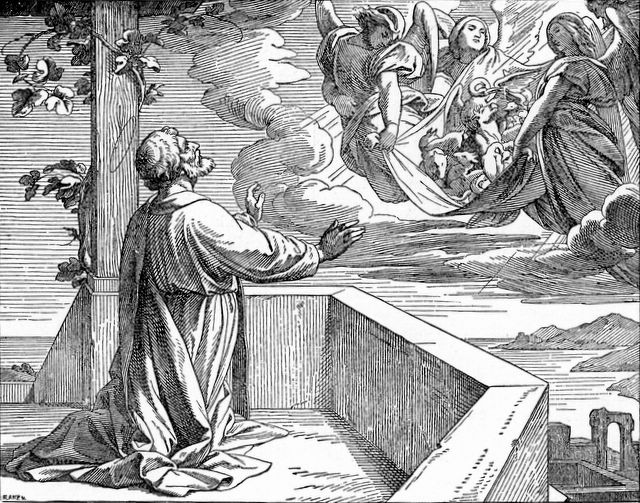
About noon the next day, as they were on their journey and approaching the city, Peter went up on the roof to pray. 10 He became hungry and wanted something to eat; and while it was being prepared, he fell into a trance. 11 He saw the heaven opened and something like a large sheet coming down, being lowered to the ground by its four corners. 12 In it were all kinds of four-footed creatures and reptiles and birds of the air. 13 Then he heard a voice saying, “Get up, Peter; kill and eat.” 14 But Peter said, “By no means, Lord; for I have never eaten anything that is profane or unclean.” 15 The voice said to him again, a second time, “What God has made clean, you must not call profane.” 16 This happened three times, and the thing was suddenly taken up to heaven.

17 Now while Peter was greatly puzzled about what to make of the vision that he had seen, suddenly the men sent by Cornelius appeared. They were asking for Simon’s house and were standing by the gate. 18 They called out to ask whether Simon, who was called Peter, was staying there. 19 While Peter was still thinking about the vision, the Spirit said to him, “Look, three men are searching for you. 20 Now get up, go down, and go with them without hesitation; for I have sent them.”

…. Peter greets the messengers, and after having them stay in his home overnight, travels with them to Cornelius’ household. There, Cornelius tells Peter why he sent for him, and Peter realizes that his vision about the animals applies especially to people – that though his religious culture fears outsiders, he shouldn’t call anyone unclean. ….

34 Then Peter began to speak to them: “I truly understand that God shows no partiality, 35 but in every nation anyone who fears him and does what is right is acceptable to him. 36 You know the message he sent to the people of Israel, preaching peace by Jesus Christ—he is Lord of all. 37 That message spread throughout Judea, beginning in Galilee after the baptism that John announced: 38 how God anointed Jesus of Nazareth with the Holy Spirit and with power; how he went about doing good and healing all who were oppressed by the devil, for God was with him. 39 We are witnesses to all that he did both in Judea and in Jerusalem. They put him to death by hanging him on a tree; 40 but God raised him on the third day and allowed him to appear, 41 not to all the people but to us who were chosen by God as witnesses, and who ate and drank with him after he rose from the dead. 42 He commanded us to preach to the people and to testify that he is the one ordained by God as judge of the living and the dead. 43 All the prophets testify about him that everyone who believes in him receives forgiveness of sins through his name.”

44 While Peter was still speaking, the Holy Spirit fell upon all who heard the word. 45 The circumcised believers who had come with Peter were astounded that the gift of the Holy Spirit had been poured out even on the Gentiles, 46 for they heard them speaking in tongues and extolling God. Then Peter said, 47 “Can anyone withhold the water for baptizing these people who have received the Holy Spirit just as we have?” 48 So he ordered them to be baptized in the name of Jesus Christ. Then they invited him to stay for several days.

Points of Interest:

  • Peter has been the hero of the early chapters of Acts. In this series of events, though, Cornelius is the most impressive character and Peter occupies the humble position of a learner. The best leaders continue to adapt, learn, and grow, as do the best followers of Jesus.
  • Cornelius being a Gentile captain of a 100-soldier Roman division would have made him suspect in the eyes of first century Jews and Christians alike. Our author tells us he was actually a good guy. (However disgusted we might be by slavery, Cornelius’ slave ownership wouldn’t have ruined his reputation with Acts’ original audience – most high status Romans owned slaves.) Cornelius was also a God-fearer; God-fearers were non-Jews who didn’t convert to Judaism but respected or even worshipped the God of the Jews.
  • Cornelius and Peter both have strange and vivid afternoon times of prayer. God gets Cornelius’ attention, and Cornelius acts on the vision he gets during prayer. The next day, a hungry Peter dreams of God trying to get him to eat all kinds of food that God’s law commanded him not to eat. What was that about?
  • Well, God can apparently change God’s law. I like that the voice – presumably from God – blames Peter for calling these animals unclean or profane, when Peter didn’t exactly make that idea up himself. It comes from the Levitical holiness codes in the Bible that themselves divide all kinds of things – food included – into sacred and profane, clean and unclean. God’s either had a change of heart on this, or the purpose of this division was time and culture bound and is no longer relevant. Peter’s understandably confused when he answers his doorbell with his vision in mind.
  • In hearing that at that very moment there are Gentile God-fearers looking for him to teach them about God, Peter realizes the point of his vision. As much as it’s about animals, it’s even more about people. God’s including all people, all cultures, all tribes in God’s family, on equal footing. This is a central, lynchpin insight in the book of Acts, one that Peter and most early Jesus followers didn’t see coming, and one they had a hard time learning as well.
  • In the moment, though, Peter gets it. He enters Cornelius’ household, tells them they too can be accepted by God, and gives them a summary of the life and good news of Jesus. Jesus is impressive, Jesus died and then beat death, God put Jesus in charge of all things, and Jesus offers forgiveness and peace.
  • As evidence of their inclusion in God’s family, Cornelius’ household experiences the filling of the Holy Spirit. Perhaps, given the historic significance of their new faith, it helped them and Peter that the Holy Spirit’s presence was so physically and spiritually obvious to everybody.

Prayer for our six – Perhaps some of your six have had spiritual interest or interest in God but haven’t been attracted to a particularly Christian expression of faith, or have felt excluded or distanced from what they know of Jesus-centered faith. If so, pray that God would communicate the good news of their inclusion in God’s family. Pray that each of them, to whatever extent they respect God, would have their faith become deeper and more personal.

Spiritual Exercise – This week our spiritual exercise will focus on hearing an invitation from the Spirit of God to a joyful life and welcoming the power of the Spirit of God to that end. What joy would you experience if you had the opportunity to show someone else they can be accepted and known by God, and fully included in God’s family? Pray that the Spirit of God gives you power to have this experience.

Additionally, are there any particular people or people groups that your own faith or religious heritage has taught you to believe are unacceptable to God? Ask God if there are any ways you need to adapt and learn and grow in your understanding of God’s family.