A Star is Born: What a Difference a Gaze Makes

by Helen Lee

SPOILER ALERT: some spoilers from the film A Star is Born may follow. So if you were hoping to see it, wait to read this until later! 

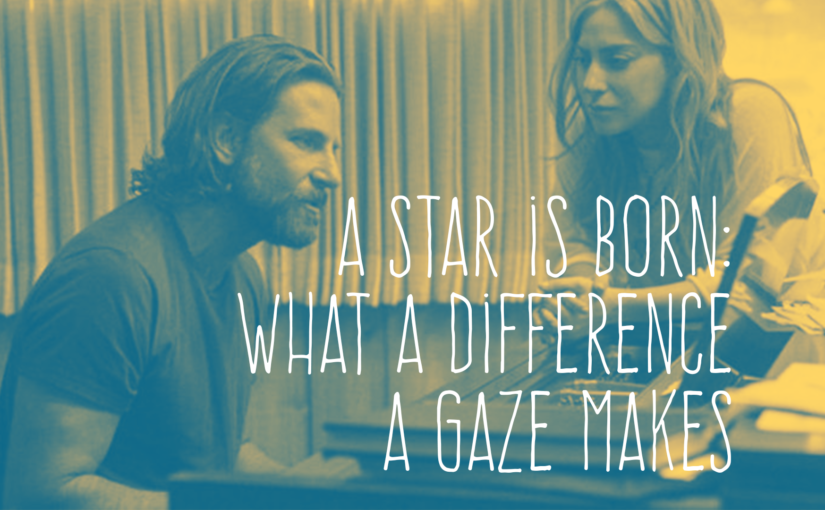
A new re-make of an old-ish story, Bradley Cooper’s A Star is Born tells the story of human fragility: of our fragile hearts, our fragile egos, and our fragile bodies. And importantly, it tells a story of the redeeming power of a loving gaze, and the crushing danger of gazes that lack love.

Saving Gaze

Ally is a talented singer who has resigned herself and her talents to singing in a drag club, where she’s beloved, and the only female they’d ever let sing there. She’s given up on “making it” anywhere else as a singer before starting, after internalizing the message that she is not the whole package. Thus far in her life, she’s been told enough times that she’s ugly that she believes it.

Ally even utilizes the make up techniques of drag queens to make herself performance ready. The artistry of drag makeup notwithstanding, these techniques are designed to create the illusion of a radically different appearance (as opposed to an augmented or touched up appearance). We learn early in the movie that in order for Ally to be presentable on a stage, she can’t appear to have the eyebrows, hair, or nose she was born with — or so she believes.


But in Jackson Maine, Ally is confronted with a sudden and loving gaze that startles her. He weeps when he watches her sing. When he visits her in her dressing room afterward, he is starstruck — even though everyone else in the room is starstruck by him, the famous singer.

With wonder and curiosity, but without judgment or revulsion, he watches her remove her false eyebrows, interested in the purpose they serve, and hungry to see what’s underneath. When she emerges looking like her true self, his gaze doesn’t change. He sees her in disguise and out, and delights in what he sees regardless.

 

It is Jackson’s loving gaze that draws Ally out onto the stage for an impromptu performance of a song she’s only created a rough draft of. And once on the stage, it’s Jackson’s gaze that seems to give her the permission she needs to share the voice that she’s been hiding for so long because she’s been told her body is not worth looking at. In beholding her as worthy, beautiful, important, Jackson begins to undo the damage of years of body diminishing messages. As a result, Ally flourishes.

A Death Giving Stare

Tragically and in stark contrast, Jackson seems to have the opposite trajectory of Ally. Plagued with unprocessed grief over the loss of both his parents as a preteen, Jackson has self-medicated for years with pills and alcohol. The introduction of Ally into his life prompts little attempts to get sober, but Jackson’s untreated mental illness is profound. His diminishment of his own body through abuse of drugs and alcohol has been enabled by his brother, everyone close to him, and his entire audience.

Jackson bears in his own body the lie from the world that he does not deserve to flourish in mind or spirit. Never resting, Jackson is accustomed to passing out more than falling asleep, after giving himself to the hungry eyes of everyone who feels entitled to his person. The loving gaze of Ally is a light in his dark, but she cannot single-handedly save him. In fact, the system of enabling around Jackson is so robust, that although Ally knows he needs help, she probably never appreciates how deep his need is until it is too late.

Jackson’s rock bottom comes as the kind of public humiliation none of us can imagine enduring. I had to watch this scene with my hands over my face, peeking through the cracks of my fingers. As Ally accepts the Grammy Award for best new artist, a drunk Jackson joins her on stage in front of the massive Grammy audience in addition to the millions of people watching on TV. He steals her moment, rambling incoherently, and then loses control of his bladder, wetting himself on the stage and collapsing. He goes to rehab soon after this.

Jackson’s return from rehab is loaded with hope. He’s clean and sober. He’s eager to get home. He loves his wife. He loves his dog. But in rehab, Jackson has been protected from the unforgiving stares of the world, and, sober, Jackson is still profoundly grieved and mentally ill. In rehab, Jackson has the support of group therapy and rest to hold him in his  now unhidden depression; out of rehab, he faces the same unfiltered and unforgiving, entitled gaze of the world.

One stare in particular seems to confirm Jackson’s crushing sense of worthlessness, and it comes from Ally’s agent, Rez. Rez takes advantage of a rare moment alone with Jackson to tell him that in spite of his work in rehab, in spite of his love for his wife, he will always be a black mark on her career. He will always be an embarrassment to her. The world will always see the humiliated man from the Grammy Awards when he stands next to her. In Jackson’s last moments with Ally he learns that she has decided to cancel her tour. Taking this as confirmation that he is, as Rez says, an insurmountable burden to his wife, Jackson resigns himself then and there to end his bodily life.

Jackson’s brother Bobby asserts later that his brother’s suicide is entirely his own fault. Perhaps it’s true that Jackson died at his hand alone, but can we expect a person to survive in a world that glares at him and calls him worthless? We are so fragile, after all.

You are not the sum of some series of unfortunate events, whether they were seen by only a few, or by the entire world. You are not an embarrassment or a black mark. You are precious and beloved. Your mind and spirit are worthy of flourishing; your body deserves care and is beautiful to behold. You are worthy.

We Are Only Dust

One of the areas of consensus between most faith traditions and science is that all of us are made out of dust. We know the names of all that dust now. You and I are both a heaping pile of oxygen, carbon, and hydrogen, with a few handfuls of nitrogen, calcium, and phosphorous, and trace amounts of other elements. We now have a general sense of where all that dust came from as well – from our food and before that our mama’s food and a long time before that from dying stars. But the basic insight has remained the same. Like our pets and predators and pens and paper, we are all made out of dust.

In the Jewish scriptures, adopted by both Muslims and Christians, this insight sometimes takes a tragic note. In the human origin stories, our dustiness is associated with our tiring labor for survival. We are told that in this hard life, “You are dust, and to dust you shall return.” (Genesis 3:19)

In the bleak existential poetry of Ecclesiastes, the poet also notes our earthy mortality in despair. For the fate of humans and the fate of animals is the same; as one dies, so dies the other. They all have the same breath, and humans have no advantage over the animals; for all is vanity. All go to one place; all are from the dust, and all turn to dust again.” (Ecclesiastes 3:19-20)

I feel this. I really do. Two nights ago I had a dream that someone I love died in a tragic accident. The next day I heard the news that a friend and colleague’s sister was terminally ill. Her kids are still in single digits. Ashes to ashes, dust to dust – it’s terrifyingly true.

As a pastor, I’ve said those words at too many funerals. I’ve looked out over coffins at grieving families and friends, trying to offer words of meaning and hope. I’ve poured ashes back into the earth and into the sea. I’ve sat with the ill and the dying – reading, whispering, singing to them in their rooms while the hospice worker or spouse takes a break; praying over their vulnerable bodies in their hospital beds. To be a member of the clergy of any faith is to be intimate with the dead and the dying.

All this has made it abundantly clear to me that as exalted and powerful and extraordinary as our species is, we are also very much of the earth. Out of the dust we are, and to dust we will return. That’s sobering. Yet it’s nothing like all bad news. For me, to know deep in my bones that we’re all of the dusty earth has been a profound source of help as well.

My own dusty mortality has been critical in my self-acceptance and – somewhat more slowly perhaps – in my acceptance of others. While the scriptures speak of our mortality in terms of tragedy, they also do so in terms of compassion. From the Bible’s songbook, we read:

 As a father has compassion for his children,
so the Lord has compassion for those who fear him.
  For he knows how we were made;
    he remembers that we are dust.

– Psalm 103-11-14

Unlike ourselves, the God of the Universe is relaxed about our weakness, and understanding of our flaws, because God knows we are dust.

A friend of mine sent me an article on obesity today, particularly the great shaming that those of us who are overweight so constantly endure – from our culture, from ourselves, and even from our physicians. One of the takeaways was to wonder what it would be like for our sanity and health if we just were to accept that we each have to do the best with the body that we have. To be kinder to ourselves, and to experience greater kindness and acceptance from others, would have a greater impact on our health and well-being than any well-meaning advice or criticism.

When I am most disappointed in myself or someone else, this has become my new mantra. We are only dust. When I remember this, I am reliably nudged toward acceptance and compassion, and better things happen next.  

Secondly, the remembrance of our common origins and destiny in the ground has given me a greater sense of connection, both to other living things and to the earth. As much as spirituality and religion has always tried to help us come to grips with our mortality, it has also been concerned with our interest in figuring out our place in this world.

We face something of an epidemic of loneliness and alienation in our age. I know I personally both experience and fear loneliness even more than death. And yet to know that my neighbor and cashier and sons are all dust, that the public figures I most adore and those I most resent all share my same material origins and destiny, is to remind me that we are all connected. When I’m nervous or unmoored, I can literally touch the ground and know that no matter where I am, I am at home.

Finally, knowing we all are dust has sometimes given me profound hope. In my work with the dead and dying, I have seen suffering and frailty and despair. But as much as I have seen these things, I have seen the miraculous and ethereal dignity and beauty of the human spirit. I have heard stories of unexpected amends made as people face death. I have listened to the bone-deep faith and assurance of the dying that this is not the end of them. I have seen transcendent peace on the faces of the suffering and emaciated. We sing a song in my church now and then where we say to our Maker, “You make beautiful things out of dust. You make beautiful things out of us.”

The dust from which we’re made has coalesced into bodies that somehow find room for beauty, aspiration, hope, joy, and love, often even in the bleakest times and places. As we hear in Jurassic Park: Life finds a way.

From dust we come, to dust we will return. But what dust we are now. And as to what we are becoming – who’s to say it won’t be even more stunning?


5 Resources to Help You Flourish: September

Steve Watson

Reservoir exists to help people connect with Jesus and flourish. We think the right church can be a good part of that happening, so we enjoy being a church that can help you discover more of the love of Jesus, the gift of community, and the joy of living. But we’re also aware that there’s a lot more to a flourishing life than church and that at any given time, church isn’t for everyone.

So each month, we’re sharing a few resources we’ve been enjoying and finding contribute to a flourishing life for us. This month’s top 5 is from me, but in the future, I hope to feature contributions from others in our community as well.

  1. Getting outside in New England

    It’s Fall now, and that’s my favorite season, partly because Greater Boston and New England really shine this time of year. If you haven’t yet, you need to get outside and enjoy it. Three really great spots for Saturday walks among the changing foliage, all just a bike or MBTA ride away, are the Arnold Arboretum, the Middlesex Fells Reservation and the Blue Hills Reservation.  Run on the trails, take a walk, hike a bit – you’ll be so glad you did. If you have access to a car, and want to get outside the city, there are hundreds of amazing places to go. Personally, I recommend a half day on an apple farm (Russell Orchards and Brooksby Farm are my childhood picking grounds) or a day’s hike in New Hampshire’s White Mountains. The closest spot along Rt. 93, the Franconia Notch area, is just stunning. More and more research suggests you’ll be less anxious, more grounded, and happier if you get outside in natural environments. What are you waiting for?

  2. Rising Strong as a Spiritual Practice – Brenee Brown

    Late this summer, while driving about with our two teenage and one preteen child, my wife started playing a sociologist’s lectures for the family. A surefire way to put everyone to sleep or start a rebellion, you’d think, but no, they were gripping for everyone. This sociologist is the very famous Brenee Brown, and the lectures were from her work Rising Strong as a Spiritual Practice. This material, in any form, is just stunningly good and is helping save my life right now. I’ll give at least one talk this fall that’s rooted in some material that landed really well for me. There are loads of great stories and ideas around belonging, resilience, forgiveness and more of the elements and experiences of being a whole-hearted person. You can buy the audio, listen to it for free like we did on the hoopla app, or check out the book the material started in.

  3. Geoffrey Owens and the dignity of work

    An interesting story I followed in the news this month had to do with the former Cosby Show actor Geoffrey Owens, his part-time job at a Trader Joe’s, and a public dust up on what does and doesn’t constitute meaningful work. People assumed that his entry level employment meant he had wasted his money or was a vocational failure. I love the way the story turned to validate Owens and all forms of honest, decent work. In his Good Morning America interview, Owens said, “People are rethinking what it means to work, the honor of the working person, and the dignity of work.” Perhaps you have or have had a job that seemed beneath you. Perhaps your pay or job status has frustrated or humiliated you. Or perhaps you’ve looked down on someone else’s work or career accomplishments. All this has been true for me at some point. To me, this story is a great reminder that job status and pay do not measure meaning and that there is value in all kinds of work and contributions to our greater flourishing.

  4. Bob Marley throwback

    Speaking of how we measure flourishing, wealth, and meaning, this very old and short clip of an interview with Bob Marley has been stirring me as well. Just after Marley has become an international sensation, an Australian television interviewer asks him whether or not his music has made him rich. In seconds, Marley manages to confuse the interviewer, upend the meaning of the word “rich”, and start a whole new conversation on meaning and life. Rich in life forever – ask yourself what will give you that today, and see where that trail takes you.


  5. “My Rapist Apologized” and similar stories

    In my first draft of this blog, #5 was one of my favorite novels I read this summer. That can wait, though. This week, as the Brett Kavanaugh hearings have brought teenage sexual assault into the news, I’ve been moved by two different stories of sexual assault that included some measure of apology or amends. The Atlantic published Deborah Copaken’s essay “My Rapist Apologized,” and The New York Times podcast covered a related story from Caitlin Flanagan. Both pieces explore the impact of implicit or explicit sorrow, regret, and apology for the survivor of sexual assault. Don’t get me wrong; neither woman says an apology makes everything right, not at all. But for people interested in a faith that centers the teaching and practice of amends, confession, forgiveness, repentance, and the like, both women’s voices stir powerfully. Feel free to skip these if you’re overdone or over-triggered by this topic in our year of #metoo, but I wanted to pass these on.

I hope you enjoy some of these resources for your own flourishing life. If you have ideas for things we should include in future lists, send them to me at [email protected] with the subject “Top 5” in your message.

Everyday Flourishing and our Hunger For One Another

Ivy Anthony

Recently we asked our congregation, “what is one of your deepest fears?”  The response was varied, as one might guess – however, there were a cluster of answers that centered around the theme of loneliness; “I’m fearful of being alone”, “I’m afraid of dying alone”, “I’m afraid I’ll never find someone who I truly connect with”.

It seems that much of these fears are a reflection of our ever-growing disconnected society. And not only is “I’m afraid of being alone” an answer that comes from an unknown point in our future; it’s also a sentiment that 1 in 4 Americans feel now**.  A quarter of Americans say that they have no one to talk to, including their family, about their troubles or triumphs.

For me this data is heart-stopping and is fodder for even more central questions to how we live in this world. Where are we? Where are people finding connection? A sense of belonging? How is it that we find meaning, and flourish in this day and age?

These questions are at the heart of Angie Thurston and Casper ter Kuile’s work in their study, How We Gather, which takes a long look at what is happening among millennials, 1 in 3 whom answer “none of the above” when asked to name their religious identity. In fact with nearly 3,500 Christian churches closing* across the country each year we know this is a conversation happening far beyond church walls – one that permeates the human soul regardless of religious affiliation. And yet flourishing is often highly attributed to a sense of deep meaning, purpose and connection – so how is it that we pursue flourishing amidst such widespread disconnection in our world?

We are made for connection, and it seems our souls and bodies suffer without it.  Kuile points out that loneliness is a greater cause of death than obesity. And yet, millennials are seeking and creating new ways of finding meaning and purpose where they haven’t been able to find it. Thurston and Kuile’s study reflects the rise of unexpected, spiritual communities that fall outside of the realm of religion. Our hunger for connection, it seems, is a driving force for new creations: Fitness communities like Cross-Fit, Soul-cycle and yoga for instance are hugely popular.  And while it would appear that people only go to these space for help in shaping their bodies – Thurston and Kuile’s study shows that many people end up staying for this sense of flourishing, found through a deep sense of community. This connection helps shape not only their bodies, but who they are and how they show up in the world as well.***

The Birthplace of Flourishing

A few weeks ago I was watering at our local school gardens. I was feeling mostly annoyed that I had to carve space for this in my busy day.  But out of the corner of my eye I spotted an older woman, likely in her 70s, coming toward me. In great human-fashion I tried to not make eye contact, hoping that she was angling for someone else.  Quickly though it was apparent that she was trying to get my attention; “Can you help me? Excuse me! Can you help me, please?”

I turned and saw that she was carrying a large piece of a lawnmower in her hands.  She explained that she had been trying to get the grass collection bag over the handles, for quite some time but was unsuccessful on her own.  We wrestled for the next few minutes to get the piece connected and in that short, divine window I gained a more expansive view of what flourishing can be.   I learned about her life, her grown kids, how her hands use to be so much stronger, how she mows her lawn every week, how she loves watching kids walk by her house to school, how the guy on the phone from the hardware store advised her to “turn the lawnmower bag inside out to correctly put it on”.

If flourishing at its core is about belonging and becoming, then my hope is that the intersectionality of where I encounter God and where I encounter people is the birthplace of flourishing.  We are yearning and eager to be seen and known and included.  And we are quick to sniff out spaces that offer falsities or too much baggage to sift through. Perhaps this is why gyms and dinner tables and meet-up spots are more palatable than churches these days. There’s no pretense, no history — only the possibility of connection through ordinary life that feels accessible.

About mid-way through my assembly of this lawnmower with this 70-year old woman, I noticed that we were putting the grass bag on completely wrong (despite the hardware store dude’s advice on the phone).  But I didn’t want to stop the process and correct it. I wanted to follow this error all the way through, until we both realized it together and had to re-calibrate and start the process all over again together.   I wanted more time to laugh at us struggling to make sense of the plastic snaps, and more time to hear the grunts and groans as we tugged and pulled, and more time to watch our hands together – strong and weak, old and young(ish) – create something together, even though in the end it was completely nonfunctional. I realized in that moment on the sidewalk, lawnmower in hand, that I had found a living, breathing sanctuary in the form of another human being, and I wanted to stay in that sacred space.

It seems as though flourishing is less a linear process to a triumphant goal of air squats or kettlebell raises, and more a discover: found in our sweaty, mistake ridden, messy, sometimes inside-out kind of lives. Flourishing erupts in our hearts as we run to each other and say, “excuse me, can you help me?”

Paidrag O’ Tuama is an Irish poet and theologian who leads the Corrymeela community of Northern Ireland — a place that has offered refuge and healing since the country’s violent division. O’Tuama says that “belonging creates and undoes us both”.  This lawnmower woman undid me.  In that shared moment, I felt joy, I felt strength, I felt connectedness, I felt time sharpen and slow, allowing me to notice elements that I never would have otherwise. And I felt sparks of flourishing in side of my soul that ignited a sense of depth and new creation exactly where I stood.

Take, Bless, Break, Give and Repeat.

I’m sure that Jesus is cheering all the cross-fitters and soul-cyclers in this world on with vigor.  But I also think he’s cheering on all the rest of us, who might not have the $34 per class, or the flexibility of time, or the bodies that can enter such activity to flourish exactly where we are at — where we live, where we work, where we play, where we water gardens — by embracing a posture of connectedness with all those around us.

He invites and reminds us to do this, through these 5 ways of checking ourselves against loneliness, isolation and divisiveness and upholding flourishing in our lives:

These elements of the meal that Jesus shared with his closest friends on the eve of his death remind us that to flourish is a fully portable experience.  They are an invitation to recognize that we are all part of one another, a part of this life that is meant to be shared, eaten, spoke and lived. Indeed: to flourish is to fully live.

    1. Take: take in the opportunities around you to connect with others, even if these moments seem somehow less meaningful, mundane or ordinary.(To Try: Look up and make eye contact when you are out and about.  Invite someone over for dinner that you never have. Or check out The People’s Supper for ways to join a table that you didn’t set!)


    2. Bless:  Give thanks for all that you have.  This appreciation extended to God, connects all things as fully divine and fully human. 
    3. Break:  Break rhythm, be willing to be disrupted.  These moments of surrender, in our lives makes space for flourishing to set up and spread in our beings. 
    4. Give: We are given by God to our spaces that we inhabit – to this life  – to one another. And so may we keep giving of ourselves to one another – for the continuing  process and creation of connection. 
    5. Repeat: Do this again and again.  Keep seeking each other to create and set new patterns. But repeat this with as much forward motion as you can, together with an expectation of creative production which pushes you ahead and produces as it repeats.

Do all this not only in remembrance of a living God who cheers on your flourishing; do this also with the belief that today, wherever you stand, you are ready to be turned inside-out as you share this messy life with the ones near you. You are ready to find God in the living, breathing sanctuary of another. This might just be the ticket to satiating our hunger for one another.

* Shawna Anderson, Jessica Hamar Martinez, Catherine Hoegeman, Gary Adler and Mark Chaves, “Dearly Departed: How Often Do Congregations Close?”, Journal for the Scientific Study of Religion, 2008, 47:321-328. Of course there are exceptions to the rule, including non-denominational Christian churches like Trinity Grace Church in New York City and Soul City Church in Chicago and hipster-friendly Soho Synagogue in lower Manhattan, which are growing among Millennials.

* Shawna Anderson, Jessica Hamar Martinez, Catherine Hoegeman, Gary Adler and Mark Chaves, Dearly Departed: How Often Do Congregations Close?, Journal for the Scientific Study of Religion, 2008, 47:321-328. Of course there are exceptions to the rule, including non-denominational Christian churches like Trinity Grace Church in New York City and Soul City Church in Chicago and hipster-friendly Soho Synagogue in lower Manhattan, which are growing among Millennials.

**The Loneliness of American Society

***“CrossFit is my church” – VOX

Discerning Disgust – Dignifying the Whole Person

Helen Lee

A Disgust Compass?

Several years ago, an article published on the Gospel Coalition went viral. It submitted that a reaction of disgust to someone like me is a “moral” response. The article was written by Thabite Anyabwile and was called The Importance of Your Gag Reflex When Discussing Homosexuality and “Gay Marriage”. Anyabwile’s thesis was this: In discussing the morality of homosexuality, Christians should “return the discussion to sexual behavior in all its yuckiest gag-inducing truth” because “‘gay’ and ‘homosexual’ are polite terms for an ugly practice.”

When I read this article five years ago, my first response was actually gratitude. I saw it as a really honest articulation of a feeling I think a lot of people probably have, but conceal. But it also awakened in me a new form of discernment, and since then, I have not stopped weighing my feelings of disgust whenever they might come up.

Disgust Dehumanization

This new discernment — one that is suspect of disgust in all forms — was elicited by a smart comment on that article mentioning something called negativity dominance and its connection with dehumanization. Negativity dominance is the tendency for evaluations of combinations of negative and positive things to skew negative, even when that doesn’t make sense. That’s a hard-to-read definition. In other words, it’s the opposite of “the whole is greater than the sum of its parts.” It’s: the whole is worse than the sum of its parts. It’s when a fly lands in your yogurt, and even after you remove the fly, you can’t stomach eating the rest of the yogurt.

Reactions of disgust towards parts of a person almost always lead to the dehumanization of that whole person. Disgust precludes respect, eliminates dignity, diminishes humanity. Choosing to lean in to a reaction of disgust towards part of a person will diminish your entire evaluation of that whole person. Like the fly tainted yogurt, the whole person is contaminated.

Disgust is part and parcel with dehumanization. Think of the disgust woven into racism, for example. The dehumanization of Black Americans has been tightly associated with disgust: fear of contamination, whether at the water fountain, the lunch counter, or in a potential romantic relationship. Or think of the moral judgment fat people experience, and the disgust woven into fatphobia: unchecked disgust is at the root of judgments that fat people are lazy, uneducated, or immoral.

Disgust and Embodiment

We’ve been considering embodiment lately on our blog and in our sermons, thinking about what a holistic approach to faith and living might look like: one that cares for the mind, spirit, and body. In particular, we’ve tried to hit on a main idea: we are one thing. We are not souls with bodies, or bodies with souls, or just bodies, or just souls — we are body and soul. And all of that is created and loved by God.

All of that is lovable.

All of that is beautiful.

All of that is good.

When we look at other people and we experience disgust when we see their body, or when we think about what they do with their body, we’re experiencing a knee-jerk dehumanization of that whole person, because they are one thing. Left unchecked, that disgust says that person is not lovable by God, is not beautiful, is not good. I say “left unchecked” because we are all products of our socialization — we all have baggage that might result in snap judgments, or knee-jerk disgust. But we also have grace to discern. All of us can answer our base instincts and take a beat to intentionally think:

Look at that child of God.

Look how beautiful that creation is.

Look how loved by God she is.

We have long been caught in a trap of disembodied faith — divorcing matter from spirit, and elevating spirit over matter, heavens over earth. When we’re reminded of the earthliness of a person or thing, we instinctively separate that person or thing from the love of God. Richard Beck talks about this disembodied “divinity ethic” in his book, Unclean:

Rituals of holiness and purification allow humans to approach the sacred… In short, the divinity ethic allows humans to approach the divine (allowing movement upward) while also protecting human dignity, the sacredness of the human person, and humane society (preventing movement downward). If we see a human person naked or urinating in public we are disgusted; the quarantine between the human and the bestial has been violated. And we see in our reaction the associations between disgust, social convention, dignity, and the sacred.

When we have a disgust reaction to a human being, we’re seeing that person as moving away from the divine. We’re seeing them as more animalistic. Typically our disgust reaction is closely associated with social convention. Our disgust is not some divine revelation of an intrinsic truth, but a trained loyalty to particular social conventions. A person’s disgust at pickled herring is no more a reliable moral compass than a person’s disgust at a Black person drinking from a White water fountain.

Check Your Disgust Before You Wreck Yourself

Being the object of disgust has opened my eyes to its pervasiveness. I notice it more when it pops up in my own heart. I’m starting to think it may be the very opposite of a clear word from God. Instinctive disgust (or dehumanizing) of another person reminds me of how much work I have to do. I have to be cautious about trusting my own instinctive moral judgments. When I forget the dignity of another person — body and soul — I am missing the mark. Examine disgust, whenever it pops up — its aim is dehumanization. No one is disgusting.

What God has made clean, you must not call profane
Acts 10:15

We are Body and Soul

Four years ago last month, Michael Brown was shot and lay dead on the streets of Ferguson, Missouri. After spending my adult life immersed in urban education and cross-cultural relationships, I fancied myself a pretty racially aware White man. But Ferguson and the four years since have been an ongoing summons to me to deepen my learning and action around racial justice.

The Black Lives Matter movement, and the writing of Ta-Nehisi Coates, Bryan Stevenson, and others have confronted us with a challenge: we have still not reckoned with the legacy and impact of hundreds of years of chattel slavery in America. Majority culture, in particular, hasn’t come to terms with a historical habit of diminishing the humanity of people of African descent.

Frederick Ware, author of the excellent and accessible African-American Theology, writes in his chapter on nature and science about Black theologians’ and ethicists’ understandings of this reduction of the Black body.

“In the case of African Americans, their history is framed within the context of the struggle to be human…. The moral and religious crisis of chattel slavery and the racial injustices that followed after it were rooted in a body-soul dualism that depicted Blacks as either ‘soulless bodies’ or ‘bodiless souls.’ (189-190)

A soulless body would be a sub-human, a commodity: a body suitable for labor, or entertainment, or imprisonment, but fundamentally both other and lesser. This body would supposedly hold lower capacity for genius or spiritual uplift, and so be less worthy of protection or dignity. This construct would allow a White human to claim ownership of a Black human. It would allow a public to disproportionately fear and imprison Black men as well, or to honor the athleticism of a Black man while diminishing his intellect or off-court achievements.

A bodiless soul would be a person of moral or spiritual value who is only granted that value by ignoring or reducing their embodied existence. A bodiless soul might sound initially less degrading, but it is perhaps equally dehumanizing. It is appreciating the wisdom or care-giving of a Black woman without any interest or acknowledgement in her own children or health. It is warm feeling for a Black artist or preacher, as long as his message is reduced to inspirational quotations, tamed of demands for justice or change.

Bodiless souls and soulless bodies – how diminishing. How did we get here? And how to we get past this?

The long history of White supremacy and racism, rooted in greed and colonialism, is often and well told. Europeans and their American colonizers, eager for economic prosperity, seize lands that they are eager to cultivate and commodify. In a desire to decrease costs and increase profits, they transform the ancient practice of human slavery into chattel slavery. They make peace with their crime through the social construct of race – conjuring up whiteness, inventing blackness.

There’s a spiritual and theological story behind all this, though, that isn’t as often told and examined and then abandoned. It’s the story of disembodied faith.

Disembodied faith separates matters of the spirit from grounded, physical experience. Rooted in Greek philosophy’s matter-spirit dualism, disembodied faith views the human soul and intellect as spiritual and the body’s appetites as carnal. It hopes for the redemption of an invisible human spirit while assuming the destruction of the visible world. It prizes prayer and virtue and explicitly religious culture while ignoring or despising ordinary physical existence and justice and the majority of human endeavors.  

Disembodied faith also treats people as bodiless souls. Under disembodied faith, a person’s work and longings and sex and heartbreak aren’t particularly important. What matters is their assent to doctrine, their conversion, and their religious life and character that should follow. This type of faith doesn’t match the testimony of our own human experience that all things matter, that life in our bodies can’t be separated from the life of the soul or the life of the mind.

Disembodied faith also makes it easier to see ourselves or others as soulless bodies. My children have often asked me where in the body we can find the human soul or human spirit. And the answer, of course, on purely material terms, is nowhere. A faith that is only concerned with the salvation of the one part of our being we can’t locate or measure has come to seem irrelevant in our times and is easy to abandon.

By contrast, an embodied faith helps us value and nurture all parts of the human self – ourselves, and everybody else. An embodied faith doesn’t draw false dichotomies between physical and spiritual concerns, body and soul. An embodied faith gives us permission to value, demands we value, the respect and care of all people’s bodies, even as it respects and values the less visible life of the heart and the spirit.

At Peace in Mind and Spirit: A Holistic Approach to Mental Health Care

by John Peteet, MD

I’ve always been fascinated by looking at things from different angles, trying to see what is really going on. I’m not sure why – maybe it comes from childhood growing up in the 60s in Atlanta where we experienced so many contradictions. There were the water fountains labeled white and colored in a culture that was supposed to be Christian, and there were the inspiring but odd people we knew from church (like characters from Flannery O’Connor’s short stories), and there was deep, unresolved ambivalence about the Civil War which my mother heard about from her grandfather who served in the Confederacy.

So I was excited to go North to college for a fresh, less parochial perspective. It turned out that my school had its own troubling inconsistencies (like a required pledge not to drink, dance or attend movies), but there I was captured by a vision that “all truth is God’s truth” – meaning to me not only that all ways of understanding the world have something to contribute, but that God is in the search for what is really true, and owns it all.

I don’t remember getting much help integrating my work with a vision of God’s truth during medical school or residency, but in my 40 years since as an academic psychiatrist, I’ve felt a continued pull to discover God’s beautiful and good truth beyond our human attempts to approach problems by reducing them to categories we can manage. For example – there are the distinctions we make between body and mind (or spirit). Depressed patients will sometimes ask “Do I have a chemical imbalance or a lack of faith?” As mental health professionals we often think dualistically in terms of mental, or psychological explanations rather disconnected from existential, moral or spiritual realities.  And we often further subdivide the psychological into cognitive behavioral, psychodynamic, sociocultural explanatory frameworks. Of course when your favorite tool is a hammer, everything can look like a nail. I regularly see psychiatrists in training focus on the psychiatric diagnosis rather than what is bothering the person most: a loss of hope that their life could work. At the same time I also recognize God’s work in the transformation and recovery that patients experience, and in the experience of trainees who can begin to see the existential dimensions of despair, and the importance of spiritual responses to existential and moral distress.

As I look back, this search for an integrative vision of persons and of what they can be has been central to a lot of my teaching and writing. Some examples are researching and writing about the importance of spiritual care for patients with life threatening illness; helping teach courses on the world views of Freud and C.S. Lewis, on spirituality and healing in medicine, or on Religion/Spirituality and psychiatry; writing or editing books like Depression and the Soul, and The Soul of Medicine; thinking about the role of psychotherapy in promoting virtues (If one of the core values of psychiatry is promoting healthy functioning, what do we think defines health?); calling attention to the importance of spiritually sensitive, or integrated mental health treatment. A few times it’s been possible to call attention to what seem to me the insights of a Christian perspective.

Fragmentation is so much a part of our culture (not only the one of the South in transition where I grew up), our systems of medical and psychiatric care, and of our own psyches — mine included. It seems to me that we’re all given glimpses, but need a clearer vision of God’s beautiful truth that transcends our parochial, flawed attempts to understand and heal ourselves.

I love the way that Christians have been praying for this for centuries. I expect you’ll recognize the words of this hymn written around the year 1000:

Be Thou my Vision, O Lord of my heart;
Naught be all else to me, save that Thou art.
Thou my best Thought, by day or by night,
Waking or sleeping, Thy presence my light.

Dr. John Peteet is a member at Reservoir and a psychiatrist in Brookline, Massachusetts and is affiliated with multiple hospitals in the area, including Brigham and Women’s Hospital and Dana-Farber Cancer Institute. Dr. Peteet is an Associate Professor in the Department of Psychiatry at Harvard Medical School

5 Resources to Help You Connect and Flourish: August

by Steve Watson

Reservoir exists to help people connect with Jesus and flourish. We think the right church can be a good part of that happening, so we enjoy being a church that can help you discover more of the love of Jesus, the gift of community, and the joy of living. But we’re also aware that there’s a lot more to a flourishing life than church and that at any given time, church isn’t for everyone.

So each month, we’ll start sharing a few resources we’ve been enjoying and finding contribute to a flourishing life for us. This month’s top 5 is from me, but in the future, I hope to feature contributions from others in our community as well.

  1. This summer, two of my friends published an extraordinary book entitled Solus Jesus: A Theology of Resistance. Emily Swan and Ken Wilson are the co-pastors of Blue Ocean Faith, a Jesus-centered, fully inclusive church in Ann Arbor, Michigan. Emily and Ken write theology, but it’s theology grounded in their lived experience and is both accessible and practical.Solus Jesus covers a lot of ground. The first section of the book argues for the validity of our human experience in matters of faith, describes what it’s like to follow Jesus as a living teacher, and argues that we are starting to experience large changes in Christianity that might help us flourish in the 21st century. The middle section of the book examines the implications of the anthropologist and critic Renee Girard on the significance of envy, rivalry, and scapegoating in all culture, including religious culture. Emily and Ken write movingly of their own experience being scapegoated and rejected by some church circles because of their coming out as a queer pastor and an ally.The final section of the book fleshes out a Jesus-centered, inclusive faith that is muscular enough to ground us and resist injustice.While Emily and Ken’s work is original, it’s also grounded in a long tradition of wise and brilliant writing and talk about God that comes from the margins of power, leaning into faith to resist their own diminishment. It’s a tradition they reference extensively.
  2. The second resource is really a cluster of resources to help us in our thinking and conversations around race. Several friends recommended I read Austin Channing Brown’s memoir, I’m Still Here: Black Dignity in a World Made for Whiteness. Many of my Black friends resonated with Brown’s journey of coming to love her own blackness. The book also exposes the limits of the supposed diversity of many of our institutions and calls us all to move out of and beyond whatever White supremacy we have internalized. A podcast I enjoyed that looks at some of the same topics from a different angle is Freedom Road Media’s interview of Reggie Wiliams by Lisa Sharon Harper. Williams is a scholar, but in this episode, entitled “Black Men’s Magic”, he quite gets quite personal. He explores historical constructs for Black manhood that have been oppressive to him and talks about ways he and others are experiencing the freedom and power and beauty of Black men.In my own Asian-White interracial household, a lot of our conversations about race this summer have been in reference to Asian and Asian-American pop culture. For us, it’s been the summer of Crazy Rich Asians, Awkwafina, and To All the Boys I’ve Loved Before. Recently, in The New York Times, Kelly Marie Tran writes about her experience as the first woman of color to play a leading role in the Star Wars franchise. Her piece gets at the marginalization of Asian-Americans in pop culture and her own growing resistance. I came away excited to hear more from her.
  3. One of the areas where flourishing can seem elusive is in our workplaces. We can wonder if we need to find a better line of work or maybe just give up on our desire to find meaning and purpose and happiness in our jobs. But what if how we think about our work can give us more joy and purpose, not matter what our work is. This is the premise of one of my favorite ever episodes from Shankar Vedantum of NPR’s Hidden Brain podcast. This summer, they rebroadcast their episode “You 2.0: Dream Jobs.” It highlights psychlogist Amy Wrzesniewski’s work on how people can find satisfaction in their work through recasting their job in terms that are meaningful to them. Whether you’re a boss who wants a better culture in your workplace or a person who’s bored or restless in your current work, this is a great episode for you. I’ve found it really helpful in thinking about my own satisfaction at work.
  4. I’ve read a lot of good novels recently, but one of the more intriguing was Roland Merullo’s The Delight of Being Ordinary: A Road Trip with the Pope and the Dalai Lama. The premise is that Pope Francis wants a break from being famous and wants a clandestine vacation as an ordinary person. His cousin and personal assistant is drafted to make plans. It just so happens that they escape from the spotlight together with the Dalai Lama and the assistant’s estranged wife and that both the Pope and Dalai Lama have some similar dreams and premonitions they are compelled to explore. On the one hand, this is a road trip novel, entirely fictitious. And yet most of the Pope’s and the Dalai Lama’s musings within are captured from real life interviews and speeches. I didn’t find Merullo’s anti-religious bent he steers things in especially satisfying, but the novel’s portrayal of two famous leaders’ ordinary spiritual lives is winsome and appealing.
  5. Lastly, I’ll recommend an episode of a podcast that our group of churches puts out – the Blue Ocean Faith podcast. This summer’s episode with Erin Lane was compelling. Erin Lane is an author who has written about women’s experience in churches and about Christians’ desires to avoid churches altogether. She’s also been involved with the Center for Courage and Renewal, an institute interested in the intersections of faith, compassion, justice, and integrity, and associated with author Parker Palmer. Lane talks about all these things and more in a really fascinating conversation with our podcast hosts. Search “Blue Ocean Faith” in your podcast app.

I hope you enjoy some of these resources for your own flourishing life. If you have ideas for things we should include in future lists, send them to me at [email protected] with the subject “Top 5” in your message.

What the Idolaters Got Right

Seeking a God Within Reach

In my tradition’s sacred texts, one of the things that most sets God off is idolatry, the worship of things or persons that are not the one God. Abraham’s children developed religion and culture in an area where most people worshipped many gods. These gods were invisible spiritual beings governing the forces that most dominated their lives: rain, crops, children, and conflicts. Earlier human cultures were perhaps better in touch with just how terrifying life can be. Too much or too little rain, too few or too many children, the moods and ambitions of local rulers – life or death, poverty or flourishing rode on these things, all of which were absolutely out of your control. It’s no wonder you’d want to enlist some help from above.

In come the idols. Idols were physical images of invisible spiritual beings, representations you could venerate, and use to give focus to your prayers for help. They brought the spiritual close to you, right into your home.

Archaeological evidence seems to indicate that the practice of making and keeping idols was very common, not just in the surrounding Ancient Near East, but amongst Abraham’s children as well: the spiritual and sometimes biological ancestors of today’s Jews and Christians and Muslims. So the scriptures’ crusade against idols isn’t targeting surrounding nations so much as it is these children of Abraham. They voice a frustration on the part of a living God that people are so drawn to these idols – partly because they are rivals to people’s devotion, but largely because they simply do not work.

So perhaps the idolaters got some things wrong. At least according to the scriptures, they misunderstood the nature of God and sunk time and resources into spiritual practice that didn’t deliver what they were hoping for.

But I’m struck by what they got right as well. They wanted an experience of a divine being that didn’t just live beyond their reach. They wanted worship to engage their lived experience more than their theoretical understanding. And they wanted spirituality that could speak to their fears and actually help.

I’m pretty sympathetic to those wants and needs. Like yours, my world has its troubles. This past week, a friend told me he relapsed out of recovery and into addiction. Our president made me want to vomit. I thought about my three children in secondary school and how I’m not sure how in the world they’ll afford higher education. Two different friends reminded me that the human race isn’t doing all that great at ensuring the survival of our species. My own instinct in this is also to reach for something that offers more escape and distraction than it does presence and help.

I too want faith and practice that can make some sense out of this chaos, and build in me greater hope and courage in these times. If nothing else, I’d love to know that I’m not alone.

Like the idolaters, I want the divine brought close. I want a god in a body

The Embodiment of the Invisible God

And my tradition tells me that is just what I have. One of my favorite lines about Jesus comes from a first century letter, known by the city of the people who first read it. It says, “Jesus is the image of the invisible God.” Jesus is the “idol” we’ve been looking for, with the twist being both that he is the real deal and is also not made out of wood or stone. Jesus is God in a body, just like ours. So a faith that has anything to do with Jesus is going to also be embodiedholistic, engaged with the totality of human experience, reckoning with the specificity of our minds and bodies and cultures and communities.

The implications of this are manifold and stunning. But I’ll wrap up with three that I’ve been unpacking and enjoying and finding helpful myself

Embodied faith affirms the created good of all the material world, myself and all the people and things I love and hate included. Not only can I hope there was a personal spiritual force behind the big bang and evolution and however else all the elements combined to make blood, sweat, tears, and all the other stuff of my universe. But I can also trust that all of it is good enough, and interesting enough, and important enough to be worth an in-person visit and ongoing commitment from the God above, behind, and beneath it all. All of it, all of us, matters. And at some fundamental level, it’s all good.

Embodied faith also steers me toward flourishing relationships and grows my capacity for them as well. If people, let alone all other living and non-living things on earth, are of deep value, than I’m incentivized to act as if this is so. My neighbor, my child, my spouse, my brother, my enemy – they are all connected to me and they all matter. I want to live in love and at peace with them, whatever challenges that provokes. It also just so happens that God, on that embodied Jesus field trip, has given me access to all kinds of teaching and practice of love and compassion and truth telling and boundaries and more that might give me a shot at connecting well with others, and staying connected.  

And embodied faith tells me God is with me always, in all places and in all things. In all the chaos of my life circumstances, some of which I’m mentioned here, I think my deepest fear isn’t that it will be hard, but that I will be helpless and alone. God in a body says to me that God is close at hand, that God suffers and rejoices along with me in life, walking through it all in solidarity and in love.


Embodied, Holistic Faith

A Whole Body Approach to Mental Health

This summer I read a book on exercise and the brain that helped me think about how my own understandings of faith and human flourishing have grown over time.

The book is by the highly acclaimed psychiatrist Dr. John Ratey. It’s his work Spark: The Revolutionary New Science of Exercise and the Brain. Ratey stars his book in an innovative high school physical education program and ends with a rousing call to a more rigorous personal exercise regimen. In between, he reviews a great deal of research on the benefits of exercise for the health and resilience of our brains, including how exercise can help us learn and reduce troubles associated with stress, anxiety, depression, ADHD, addiction, and aging.

Wow, I thought – that’s good news! And the work confirms my experience with the role running plays in my own mental health and managing of ADHD, and with the help it’s been to a number of my friends in recovery. I think running gives me clarity and focus, just as a number of my friends find it helps them be less inclined to return to their drug addictions.

Turns out there’s science backing this up: Ratey affirms the value of therapy and of medication at the center of his field but is clearly wanting to broaden our approach to and understanding of mental health. He writes:

The problem with the strictly biological interpretation of psychology is that we sometimes lose sight of the fact that the mind, brain, and body all influence one another. (119)

We needn’t treat mental health issues as disembodied problems we talk or medicate ourselves out of. We can explore how the use of our bodies is integrated into our mental health as well.

Ratey also quotes his colleague, the psychologist Dr. Robert Pyles, who says:

Exercise saved my life. I think running really put me back with the unitary nature of body and mind – it’s all one thing. We’re not split into pieces. (83)

For Ratey, exercise was part of his way out of a serious lymph system disease that was accompanied by immense stress and significant depression.

We’re all one thing – we’re not split into pieces.

Sometimes we lose sight of the fact that the mind, brain, and body all influence one another. We are whole people, embodied people.

What About a Whole Body Faith?

What Ratey wants for psychology and psychiatry, I want for faith and religion.

For good or for bad, people of faith have had lots to say about matters of the spirit. Wonder about how to go to heaven when you die? Where and when and why to pray? What it means to be a good and righteous person? Religious communities have an answer for you, or at least a direction to point you in.

Those are not the questions my friends and I are asking about our lives. Being saved doesn’t make the kind of intuitive sense to us as being well. Tending to our spirits doesn’t make sense apart from tending to our minds and bodies as well. If faith is going to speak to my life, it’s going to need to speak to my real, authentic self.

I’m serious about my exercise, but I put more into my practice of faith. Not because I’m afraid of hell or particularly motivated to a more moral or spiritual person. No – for me, faith centers, grounds and nourishes my whole, embodied person.

An embodied, holistic faith gives me resources to make peace with my past, so I can live a freer future.

An embodied, holistic faith helps me accept mental and physical disabilities, navigating my own and others’ with more compassion and grace.

An embodied, holistic faith gives me tools to be more connected and at peace with others.

An embodied, holistic faith moves my experience of sexuality beyond shame or pleasure and into intimacy.

An embodied, holistic faith validates my anger in the face of injustice and fuels passion and courage to act.

If we’re all one thing, all whole and embodied people, we need an experience of faith, a practice of spirituality, and an approach to God that validates and nourishes the whole of our bodies and life experience, and equips us to flourish and be agents of the flourishing of our neighbor and our world too.