
Thanksgiving (When Capitalism Lets You Down)

With Thanksgiving this week, and the Christmas season around the corner, let’s take a moment to get ready. At its best, the holiday season can be a time for  gratitude, wonder, joy, and connection. But to welcome something good, we need to make room for it. So let’s first take a moment to notice the stress, the shame, and the violence that can choke out our joy, wonder, gratitude, and connection.. 

I spend a lot of time around fellow working parents, people who when I ask how they’re doing, they start by sighing. There’s probably nothing that new to this – midlife has always been a time when responsibilities and burdens tend to pile up. What’s new these days is how many kids feel the same. Ask your nearest teenager if they’re stressed out and see what they have to say. Many of us are stressed out a lot these days. 

Before we think about solutions, it helps me to remember that the system we’re living in is getting results for which it was designed. If you didn’t listen to the New York Times podcast 1619 this year, I highly recommend it. Remembering 500 years since the start of slavery in this country, the podcast explores some of the legacy this part of our country’s history. In the second episode, “The Economy That Slavery Built”, we learn how America’s burgeoning cotton industry rocketed the American economy toward wealth in the early 1800s. The three keys to this story of American wealth: technological innovation, stolen land, and enslaved workers. By 1850, three million African descendants are toiling in this country – without pay, without rights, living under brutally violent conditions. They’re working on land taken from displaced Native Americans. And this land and labor is enriching a relatively small number of wealthy American descendants of European colonizers. It was in this context that American capitalism found its legs. 

I’m not an economist. So I have no argument to make for or against capitalism. But in our 21st century American economy, in which the richest three Americans hold more wealth than half of this country’s residents, I find it relevant that  American methods of producing and growing wealth involved began with practices like slave-backed mortgages, stolen capital, and unpaid labor. Relentless, poorly paid, and unpaid work as a source of wealth and convenience for others wasn’t invented by Amazon or Walmart. And an economy that produces wealth and ease for people at the top and center, while pushing violence and costs out to its edges and bottom is nothing new. 

It’s as participants in this economic system that most of us have more debt and less savings than we want, that most of us are busier and lonelier than we want to be, and that most of us hit the holiday season tired and stressed out. We absorb constant messages that we do not have enough, and that buying more will bring us joy. And we are constantly told that we are not enough, and that if we work harder, we might become worthy. These messages are saturated in idolatry – false promises of security – and packed with lies. 

The systems we live in are bigger than all of us. I don’t have a plan to change all this. But as a pastor in the good news of Jesus tradition, I do want to invite us toward freedom. I want to invite you to walk away from some of this crushing stress so you can make room for joy, gratitude, wonder, and connection. 

So can I suggest three practices to consider through Thanksgiving and Christmas? These are three practices that might open up some space and perspective, that might give us more freedom, that might open up space for the gratitude and joy we would like to experience more? 

Play “What’s Not My Fault”
It’s healthy to take responsibility for our lives. But it is also liberating to name the problems we think we have that aren’t really problems, and the other problems we have that aren’t our fault. Our economy, our culture, and our inner critics shame us when we have problems, even when they’re not our fault. And shame chokes out joy and wonder.;

You can play this by yourself, but it’s even better with a friend. The way it works is you write down five problems you have that stress you out – ten if they come quickly! And then next to each problem, you write down if it’s mainly your fault or mainly not your fault. Half and half is not a choice; make a call one way or another. For instance, with three teenagers, I might write down: probably can’t afford their college education. And with Thanksgiving around the corner, I might add: relative or two I don’t know how to talk to anymore. In each case, I contribute to the issue somewhat, but in both cases, it turns out these are mainly not my fault! College educations have become ridiculously expensive, and I don’t control my relatives or how we’ve all changed over the years. 

Discovering many of our problems are not our fault doesn’t take them away, but it does lift shame and make some room to not take it personally, to pray, or to just let it go for today. And there’s freedom in that. 

This Holiday, Tell Stories of Thanks and Tell Stories of Resilience
Secondly, during the Thanksgiving weekend, take an opportunity to share stories. Though the American myth of Thanksgiving has a troubled and violent backstory, at its best, this weekend gives us the opportunity to eat a big meal and to be thankful. 

For years, I’ve been in the habit of sharing something I’m thankful for over the past year, both with family and with friends. I think this is a great habit; share a story of gratitude this weekend. And suggest to your friends or family that you share a second story. Share a story of resilience – a time when things were hard, but you got through. You overcame, or even just survived. These stories of resilience remind us that with the help of God and friends, we are strong. There is enough. Telling and hearing these stories encourage us and strengthen us. 

Participate in Buy Nothing Day (or Week, or Month!)
And thirdly, participate in the phenomenon of Buy Nothing Day. On Black Friday this year, don’t spend a single dollar. Or see if you can go a week or even longer without making a single purchase, even online. To survive and flourish these days, almost all of us need to make and spend money. But to fast from spending money for a bit – when our culture is going crazy spending – is to say the life and joy are not to be found in the accumulation of possessions or costly experiences. The greatest gifts we can give to others involve our time and attention. Making, and spending, and having more tend to make us far less happy than we think it will. If we take Jesus’ teaching seriously, we’ll need to consider that all of this may just make us more anxious. 

By opting out of this consumer culture, even just temporarily, we make space to consider what satisfies us most deeply. We open up time and space to consider what a more joyful life might look like. We may even open up attention to wonder how we can participate in the creation of a more just and peaceful world. At the very least, it will help us end the month with less debt and more peace – two pretty good things on their own terms. 

Happy Thanksgiving, friends! May joy, wonder, gratitude, and connection be yours abundantly in this season!
On Baptism, and Taking “Everyone” Seriously

I hope you’re enjoying our late fall series, Your Faith Journey at Reservoir, thus far. I opened the series focused on our church’s value for connection. We talked about how the simple process of connecting more deeply with a friend or with our natural environment can bring greater life and greater ease in connecting with God. Last week, Pastor Lydia gave us a great word on action, and we passed out a spiritual practices booklet prepared by Pastor Ivy, capturing some of our teaching on Sundays over the past several months. It’s available online now where we house resources for our community groups

As you’ll continue to hear on Sundays, a great way you can connect with Reservoir as your community is to become a member or review your membership agreement. Membership is a practical way of signifying your belonging in this community and your desire to be part of the hundreds of people that sustain this community. You can join online today, and a pastor will be in touch with you.

I also wanted to write to you about a theme from my upcoming Sunday sermon, on our value for Everyone. (“We seek to welcome people in all their diversity, without condition or exception, to embrace a life connected to Jesus and others.”) A hallmark of Jesus’ ministry was a radical expansion of God’s welcome; we find joy when we receive and extend that ourselves. 

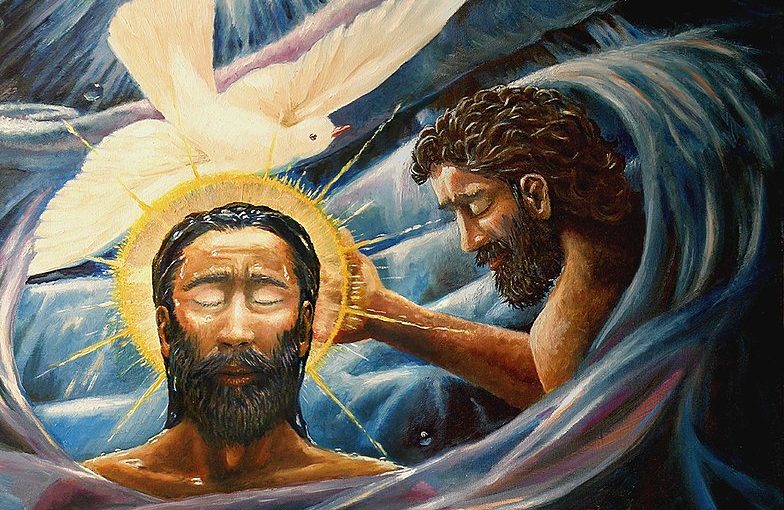
In particular, this Sunday, I’ll share some teaching on baptism as one of the most powerful ways we experience the welcome and love of God. I’ll also share that after years of prayer and consideration on my end, our pastoral staff and Board have been talking about extending baptism to any in our community who are interested, children and infants included.

A bit of background. We don’t keep records on numbers, but our church has baptized hundreds of people over the past twenty-five years. Thus far, they have all been grade school aged and older. Our church’s roots are in the Protestant renewalist tradition – churches in modern charismatic and Pentecostal denominations and unaffiliated churches like ours that emphasize and treasure lived, felt experience of God by faith. For these churches, baptism – usually by brief immersion under water – has been an opportunity to express one’s faith in Jesus. It has also been a physical taste of God’s cleansing and powerful love and a symbol of our union (being connected to, made one) with Jesus, who died and is risen. In this tradition, a person chooses to be baptized as an expression of faith and eagerness for more life in God. When parents have infants or young children, they can dedicate their children and their parenting to God, but the child will choose – or not choose – baptism for themselves when they are older.

The majority of Christian churches, both now and throughout Christian history, have also baptised children of all ages, including infants. For these churches, baptism is an expression by the community of faith that the child is known and loved by God and included in God’s family. Infant baptism is an expression of grace – that God loves and chooses us before we can love or choose God, and even when we struggle to love and choose God ourselves. Generally, when infants are baptized, they are not immersed, but a small amount of water is sprinkled or poured on their heads, with the water representing the anointing of the Holy Spirit – the loving presence of God with the child. 

For families that would like their child to be baptised, our pastoral staff and Board would like to offer this as well. A few things this would and wouldn’t mean:

  • Baptism would be available for infants and children of families who are part of the Reservoir community and want this for their children.
  • We will continue to offer child dedication for families who would prefer not to baptise their children, but would like to dedicate their child and parenting and let their child choose or not choose baptism after they grow older.
  • We will continue to offer preparation for baptism and baptism for youth and adults who would like to be baptised. This is not only for children, but a powerful rite for any person interested in Jesus-centered faith. 
  • Our youth ministry team has been thinking through best ways to prepare youth who are interested to consider baptism as they also consider ways to help youth who were baptised as children make sense of faith and church for themselves (a process that has traditionally been called confirmation, among other things.) This will continue. 
  • Reservoir will continue to honor anyone’s baptism, no matter where that happened, and regardless of when it happened. This has always been the case for us. 
  • Baptism is not a requirement for participation at Reservoir and we do not believe or teach that God requires baptism for someone to live a good life or go to heaven or anything like that. We are making available to people and families an important experience of God’s welcome and loving connection, not requiring it of anyone!

Early in the new year, we will be in touch about when and how child dedication, child baptism, youth baptism, and adult baptism will be available in 2020. Our team needs some time to work through the details. Meanwhile, If you have questions or concerns, feel free to talk with me or any of our pastors. 

We are God’s children. God loves us so and is delighted to include us in the embrace of God’s community of faith and to teach us to learn connection and life with Jesus. It’s an honor to walk with you and serve you on this journey. I’m looking forward to sharing more about God and Everyone this Sunday!

Peace,

Steve

Why and How Reservoir Invites You on A Journey

My three children are a spectacular gift to my wife, to me, and to the world. I pity the fool who’d tell me otherwise. Yet raising them to this point in their teenage years has disabused me of the notion that there is anything like the perfect child. It turns out all our kids will have flaws and struggles, just like us. 

When trying to accept imperfections, one of the phrases people like to say is: Progress, not perfection. At first it sounds liberating. I don’t need to lose twenty pounds, just one per week. My kids don’t need to earn straight A’s, just keep raising their grades. And yet, when you stop and think about it, this mindset is also a trap. It assumes that there is such a thing as perfection, that ideal me, ideal child, ideal you, ideal whatever exists, and we can feel good as long as we’re all making progress toward that ideal. 

But who gets to decide what the ideal looks like? (And before you say God, I’ll ask whose version of God? What person or culture or time period’s image?)

We were talking about this last week at a conference on justice and renewal led by the noted social psychologist and theologian Christena Cleveland. One of her many great lines was, “Perfection is the figment of the colonial imagination.” Our ideas of perfection are usually shaped by dominant people and groups, used to rank and sort people and cultures, elevating some and diminishing others. Perfection has a few winners and many losers. If we settle for progress, we haven’t changed the goalposts; we’re just trying to make peace with our slow speed in getting there.

A quick look at the trees could have taught us the same thing. There’s no such thing as the perfect tree, so there is no such thing as progress in that direction. Healthy trees grow. Their growth, their expansion signals their flourishing, no matter what beautiful form that growth takes. 

When Reservoir tries to support your faith journey, we have flourishing in mind, not progress or perfection. Our aim is for people to connect with Jesus and with our church and to thrive more as a result. We’re not interested in trying to tell you what your thriving and growth looks like; we assume you know a fair bit about that for yourself already. 

Another way of putting this is that Reservoir doesn’t think we need to manage exactly where our faith journeys should lead. But we would encourage us all to take one, to choose movement over stagnation, to see what love and peace and joy this life and the one who made it all have in store for us. 

For the next few weeks, on Sundays, we’ll rather explicitly invite you to think about your journey. Pastors Ivy and Lydia and I will talk about five ways of being in the world that seem to help us find more of God and more of the good life, five ways of being in the world that might encourage some movement in our lives. They’re not the only five, but they’re five we like, and they so happen to be Reservoir’s five core values for doing Jesus-centered community life in our time and place. They’re connection, action, everyone, freedom, and humility.

(The English teacher in me knows that one of those words is really messing up the syntax of that list. “Everyone” is a pronoun, not an abstract noun, so that sentence would flow a lot better if is said something like “inclusion” instead. But when we wrote this list a few years back, we wanted that one to stand out, and we still like how it does, so there.) 

Anyone – in fact, everyone – can show up on any of the next five Sundays or follow along with the content online. But if you like this approach, and if you’d like some company and encouragement on your faith journey, we’ll strongly encourage you to become a member at Reservoir. Membership in our church is about belonging, not believing. It’s a way of saying to yourself and the community: I belong here. I’ll let these folks encourage my faith journey, and maybe I’ll even encourage others on theirs. 

Membership – and the community and the giving it involves – is  also a way of sustaining a Jesus-centered, fully inclusive approach to faith, one that values and empowers connection, action, everyone, freedom, and humility. Like most things in life, this stuff is good, but it isn’t free. 

I look forward to connecting with you on your faith journey, to listening and learning from one another as we go. Personally, I’m not all that interested in progress or perfection anymore, but on seeing what beautiful things we will see and become as we continue. 

An Invisible Mending Material: Vulnerability

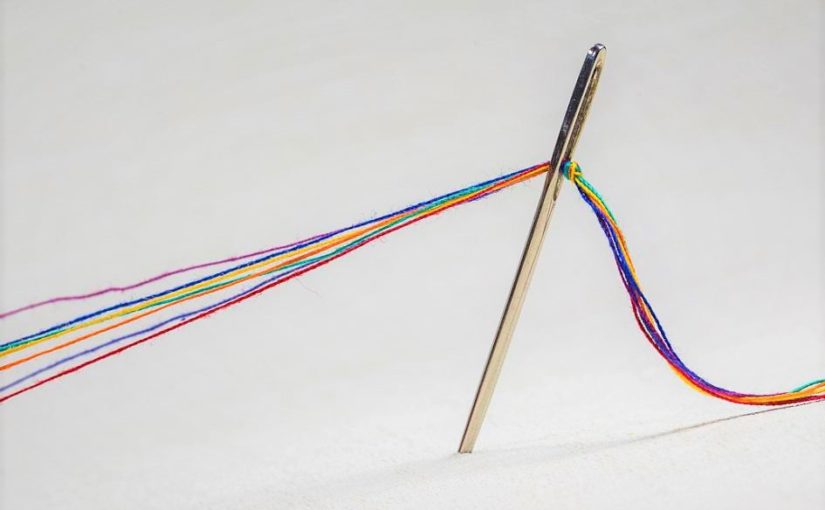
Captured between the “over and under” movement of the needle weaving its’ darning pattern – was also the vulnerable frayed edges, the torn pieces of our lives laid out alongside one another.

by Pastor Ivy

This past weekend we held our 5th annual church-wide retreat.  Steadily year after year, we’ve had a crew of 250 or so folks who join together, to step out of their regular rhythm of life and experience something new in the vastness of time and space that a retreat can afford.  We had the privilege this year, of welcoming the voice of Laura Everett, (Executive Director of the Massachusetts Council of Churches) who took us down a meaningful historical, spiritual, and tactile experience of mending.

Mending is a metaphor that is powerful and rich in it’s introspective call to all of us. It surfaces questions such as, “Where do you feel worn?  Where in you needs mending? Where are you feeling stressed, frayed, friction? How do you approach repair?”

On Saturday morning, I watched as these mending questions reached our community. I watched as the mending metaphor went beyond just an intake of historical and technical knowledge and unfolded into an integration of physicality, soul and community. Laura Everett invited each person to take a holey sock, a needle, a thread of yarn and begin the process of repair – through a technique called “darning”.  

180 adults were invited to learn something new. 
180 adults were invited to be challenged by the unfamiliar.
180 adults were invited to be vulnerable. 

And 180 adults started to darn their socks. The magic that was to transpire in that slightly worn, flickering lighted ballroom over the next hour, was of heavenly quality.  You see, the challenge was not in the technical learning of the new mending practice, (within a few minutes most people seemed to pick up the necessary weaving pattern). The challenge was in the starting. The challenge was in poking the needle through the fabric for the first time. The challenge was to find what wasn’t visibly provided in the center of the table – not the needle, the thread, nor the apple. The challenge was in finding the essential material that was located within the center of each person.  The invisible material of vulnerability. Vulnerability, turned out to be the incredibly powerful key in unlocking the process of mending. 

It is so vulnerable to learn something new, and it is so vulnerable to mend. Both, assuredly usher in a measure of awkwardness, self-consciousness, uncertainty, and fear –  which can lead to postures of concealing, ignoring or retracting.

Yet, at this retreat, I witnessed the power of entering into a space of communal vulnerability that allowed for a greater opening of oneself, of connection to others, and the Spirit of God.  

A natural nervousness spread across the room as everyone made that first needle poke into the fabric, and made the long pull of repairing yarn.  Glances flew left and right from folks to make sure that they were making the correct stitches and patterns. Helpful tips were uttered from one to another, as thread tangled or needles frustratingly slid off the long tail of yarn. Soon though, the connection across tables shifted from the learned technique that was centering everyone – and stretched into the lives and stories embodied at the tables. 

The creative, vulnerable engagement allowed for discovery of one another at deep, transparent and tender levels.  The room itself moved from a nervous-quiet, to a convivial, called-to-life tenor. There was an attention on fingers and fabric, but also an attention on hearts and stories.  The beauty found in the cross-generational connections, introvert – extrovert connections and all the manners by which we generally separate and align ourselves, was powerful to witness. 

What was being tended to, and mended at each table was more than a worn sock.  Captured between the “over and under” movement of the needle weaving its’ darning pattern – was also the frayed edges, the torn pieces of our lives laid out alongside one another:

Over: “My child’s neurological testing will come back early next week…”
Under: “I’m so alone.”
Over: “I’m trying to figure out how to move my elderly mom from her
place.”
Under:  “I needed this retreat so badly.”
Over: “I never knew that about you..”

Vulnerability, as I watched it spread throughout the room, wove a deep belief into each person.  A belief that this real life mending process is one that we don’t have to master alone. The belief that other people will lean over our shoulders and look at our efforts of mending, and sometimes laugh with us at our fumbled attempts, but also encourage us as we learn new techniques.   A belief that God is devoted to the steady, slow work of repair in us, and that God will not give up on us. And a belief that we are worthy – that our experiences of pain, rifts, weariness and oppression are worth the effort it takes to fix.   

Jean Vanier, the recently deceased founder of the L’Arche community says, 

“It is the human heart and its need for communion that weakens the walls of
ideology and prejudice. It leads us from closedness to openness,
from illusion of superiority to vulnerability and humility.”

May Vanier’s words that speak of connection and vulnerability, indeed prove to be a powerful mending force that weakens the dividing walls found in our relationships, neighborhoods, cities and nations.   The time I spent in the tiny town of Sturbridge this past weekend was an experience that pierced my heart, (my fingers at times), and sewed connecting lines of vulnerability throughout my story to so many others.  May the strength of these threads be ones that we can all reach out and grasp onto as we continue our own stories of mending. 

We invite you to go through the prayer prompts from Mend: Reservoir’s 2019 Retreat.

Tonight We Stop – End Detention Camps

One of our pastors, Michaiah Healy, delivered these words at Cambridge’s Lights for Liberty vigil to end detention camps:

Greetings. My name is Michaiah Healy. I am a Pastor at Reservoir Church. We are here tonight on behalf of our community: citizens, immigrants, refugees, naturalized, faith traditions, and cultures of every type. We stand with all of the residents and leaders of this City, to end detention camps and to protest the inhumane treatment faced by migrants, to demand human rights and human dignity for all on this land. 

Tonight we have stopped in the street, Interrupting the rhythms and patterns of our lives, to STAND together as ONE people with no divides in the purpose of our gathering. 

Tonight, we will raise our individual single light into the night sky, noticing the limits of the light cast from this candle, maybe even noticing within ourselves our own limitations, despair, or frustration.

But we are not alone in the dark of night

We stand in the power of collective light, believing that our collective light will become an inescapable FLOODLIGHT onto the suffering we see. We demand tonight as we did at the start of this great nation, for the rights of liberty and dignity for all. 

As a person of faith, the treatment done to the refugee and immigrant, in the name of the citizens and government of the United States of America, directly opposes our Christian, Confuscian, Buddhist, Hindu, Islamic, Judaic, Taoist, and Zoroastrian core beliefs and tenets of faith which say to love and care and treat our neighbor as we love, care, and treat ourselves.The Golden Rule. 

The Jewish Talmud, says: What is hateful to you, do not do to your fellowman. This is the entire Law; all the rest is commentary.

The Hindu Mahabharata says: This is the sum of duty; do naught onto others what you would not have them do unto you.

From the Islamic Sunnah: No one of you is a believer until he desires for his brother that which he desires for himself.

I come out of the Christian tradition that says to love God with all your heart, soul, mind, and strength, and to love your neighbor as yourself. Jesus said, do this and you will live. Do this Cambridge and we will live.

Jesus told a story of a traveler, stripped of clothing, beaten, and left for dead alongside the road. Leaders came one by one, passing and avoiding the traveler. Finally, a Samaritan, a despised and marginalized person, happens upon the abused man.The Samaritan stops, bandages the wounds, puts the traveler on the donkey and takes the traveler into the care of an innkeeper, expensing all care for the traveler onto himself. Many have pondered why the others didn’t care for the traveler the way that the Samaritan did. I believe the Samaritan saw themselves in the person left for dead, overlooked, left on their own. The Samaritan stopped because the Samaritan loved another as they loved themselves. 

How we treat others matters. Not only as policy but as a matter of identity and character, a means of our own survival. 

Tonight we stop because the conditions in these detention centers are deplorable.

We stop because we are alive, we are free, we have a voice, we have collective power, because we too have been in need and we want to be good neighbors. 

Where faith in government and leadership and institution has been eroded, we build it back tonight. 

We stand together as a city, across neighborhoods, traditions, economics and class, abled and disabled, using our voices and our lights as instruments of our power and unity, declaring as a city boldly, loudly, unapologetically that we are committed to truth, we are committed to human dignity, and we are committed to hospitality

Bring on the floodlight.

Peace be with you. Peace be upon you. 

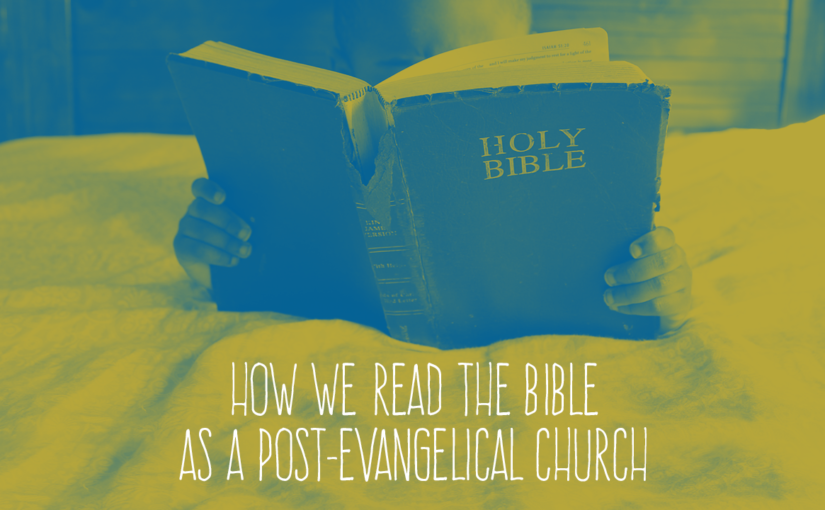
How we read the Bible as a post-evangelical church

Steve Watson recently shared in a Faith and Leadership article how Reservoir has grown in its spiritual practice of Bible engagement in a changing religious landscape.

Roger stood before our quarterly gathering of church leaders wearing faded jeans and a button-down shirt suitable for the gardening and other activities that occupied his retirement years. He sported a short gray ponytail, reminding us of both his age and his perennial countercultural vibe.


He began telling us that the Bible frustrated and irritated him and he didn’t read it much at all anymore…

Read the rest of Steve Watson’s article on Faith and Leadership

4 Ways to Pray on Your Feet This Summer

There are myriad ways to connect with God and your inner life and to offer peace and love to others. There’s also a lot of different language for doing that, some of which might land for us, and some of which won’t. Pray, Meditate, sending love and light, sending good thoughts, sending positive energy — these are all words people use for this practice of connection, hope, and longing.

And if you decide you want to take part in that practice, it can be hard to find an approach that is helpful and generative for you — centering prayer, journaling prayer, mindfulness meditation, group prayer, listening prayer, the examen (some guides to these can be found here). Again, not all of these land for all of us. If you’ve had trouble connecting with these spiritual practices, here are 4 ways for you to mix things up by getting moving.

1. Pray in a Labyrinth

Labyrinth prayer is an ancient Christian practice. A labyrinth is a walking path leading to and from a central point. It’s not a maze – there are no dead ends or traps. The experience of walking a labyrinth can be like a mini pilgrimage — one takes by all appearances a meandering walk, but the path is purposeful, and the destination specific.

  • One way to use a labyrinth is to ask God a question upon entering the labyrinth, and as you walk, pay close attention to what God might be saying to you, and feel the presence of God with you on your walk. Rest in the center, and journey back out knowing God’s love for you.
  • Another way to pray with a labyrinth would be to practice Breath Prayer as you walk. Choose a word, a phrase, or a short prayer to repeat internally as you inhale and exhale. You could slowly inhale the word “peace” and the exhale “peace” for the entire walk. Or you could inhale the words “Lord Jesus, Son of the Living God” and exhale the words “have mercy on me”.

You can use this tool to find a labyrinth near you — many churches, abbeys, and gardens have them, and many have hours for the public.

2. Prayer Walk

Prayer walking is a little bit like praying in a labyrinth, in that you are praying while walking. Prayer walking generally refers to the practice of intercessory prayer over a particular area. While labyrinth prayer is very inwardly focused, prayer walking is outwardly focused.

  • Take a walk around your neighborhood, and pray for the flourishing of all who live and pass through there. Pray that each person who walks these sidewalks, drives on these streets, and lives in these homes would experience God’s smile on them, God’s abiding presence, and the joy of connection with others.
  • Choose an encouraging verse from the Bible that jumps out to you, and that you hope would touch the lives of others. Go to a public park or walking path, and meditate on that verse with the intention of offering it to those who use that park or walking path.

3. Go Visit Someone

Get up and use your feet to spend in person, physical time with someone else, especially if you suspect they might suffer from loneliness. Loneliness is deadly and self-confirming (as we become more lonely, we develop more anxiety around human interaction, which increases our loneliness).

Don’t stay inside and pray for someone, text someone and invite them to coffee or lunch. Call someone and see if they are home, and tell them you’re coming by. Bring cards, your Netflix account, a six pack, or pastries. Leave your phone in your pocket and give that person your attention, your presence, your words, your physical contact.

4. Make Eye Contact (Or more!) With Your Neighbors

We’ve spent some time talking about neighboring here. It can be easy to isolate from neighbors in this day and age. This guide on neighboring has some practical ideas on how to be a neighbor and foster relationships with your neighbors.

Take a walk around your neighborhood like in item number 2 above; only this time, keep your attention out. If you see a neighbor, make eye contact or (gasp!) say hello. Tell them to have a nice evening. Say “I hope you’re well”. Stop and have a full conversation if you feel comfortable, or just leave it as a polite wave and a nod

Keep doing that. Next time, get one of their names.

If God Loves Me, Maybe I Can Stop Hating Myself

Yesterday, I walked into an audiology office for a hearing test and new set of hearing aids. As I’m getting fitted, I hear at full volume again for the first time in weeks. And it’s a revelation. My own voice seems odd to me, the doctor’s tone is so vivid, the sounds of the world are so clear again.

So I say to the audiologist: No wonder I’ve been so tired the past few weeks. I’ve been trying to process everything through this fog of fuzzy hearing. She gave me a knowing look and said: Your brain’s been working really hard just to keep up. Of course you’d be tired.

Suddenly, it was as if I was in therapy or confession. That brief moment of empathy was so unburdening, I didn’t know if I wanted to hug her or cry; instead, I just leaned back and took what felt like my first deep breath in weeks.

I’m not always much for these lingering deep breaths. I prize my toughness, stoicism, and independence. I’ve run marathons, one of them on a balky Achilles. When I joined a rowing studio, I trained until I had the most meters rowed per week. I know how to ignore pain and carry on. But perhaps this is sometimes more curse than gift.

The reason I was in that audiology office was because I had lost one of my hearing aids in a bike accident, the same accident in which I bruised my ribs, hip, leg and knee, while sustaining a concussion and knocking my bike out of whack. And that accident came on top of a long head cold and respiratory congestion that was long and fierce enough that it settled into a case of pneumonia in one of my kids. The Sunday just after the accident, while I was still sick, I joked at church that I’d felt a little spacey all week and could never know if it was the head cold, the concussion, or the missing hearing aid. So many options to explain my low energy and the fog in my head!

Do you know what I did last month, though? I soldiered through. I met my obligations, even taking on an extra work project that I didn’t have to, and didn’t take a sick day. When I took a few days vacation off, it was to drive my daughter 1400 miles in five days to visit colleges around the Northeast. All month, I kept pushing, aware now and then that my energy and mood were low, that I was just so tired. But not once did I ask: how do I slow down and take care of myself? What do I need right now? How can I love myself?

It turns out that many of us have difficulties loving ourselves, and these difficulties sometimes have pretty deep roots. I follow the work of the social psychologist and public theologian Christena Cleveland, who is publishing a great deal of provocative content on justice and renewal on her patreon account. In a February post on mindful self-compassion, she cited that most of us are far more compassionate toward loved ones in distress than we are to ourselves. She also discussed how we can learn to become more self-compassionate and start to reap the many benefits that come with that.

I recalled Dr. Cleveland’s words as I reflected on my revelation in the audiology office. They were an echo of some of the most significant inner work I did throughout 2018, both in months of therapy and in a year’s worth of prayer, following the 19th annotation of the spiritual exercises of Saint Ignatius. If God loves me as much as I hope, as much as my faith has taught me, as much as the Bible assures me, then perhaps I can learn to love myself.

There’s a lot to say about learning to love oneself as God loves us. I gave two sermons on this topic early this year. Even there, I was only scratching the surface, and obviously I’m very much a learner here myself. But one thing I’m learning is that to love myself, what I need matters. It’s not all that matters, for sure, but it doesn’t not matter. What I need matters to me, and it matters to the God who made and loves me as well.

So for a while, each morning, I’m going to start asking myself in the presence of God: What do I need today?

The funny thing is, this doesn’t only matter to me and to God, but it seems to matter to others in my life as well.

After the Spirit of God did that thing through the audiologist and gave me permission to admit how exhausted I’d been, I took a few minutes to sit with that self-knowledge, said sorry to myself for neglecting my needs, and talked to God about how God loves me, how God has room for my needs.

And you know what, that work of self-compassion didn’t seem to make me more self-centered, but less. Rather than lead toward self-indulgence, I noticed some movement toward a more empowered, more compassionate, and more generous life. Later that day, I had a more wholehearted conversation with someone I love but don’t always show that to very well. I also had a clearer head for a project I was thinking about. And a persistent work-related anxiety was triggered, and I experienced less worry. I thought: that’s a much smaller deal than I have made it out to be.

See, I may be harder on myself than on anyone else in my life, but hating myself does have an impact. My self-criticism starts with me, but radiates out into the lives of those closest to me, making me a harsher critic, less tolerant of weakness and difficulty. And the particular form of self-hatred that disregards my own needs saps me of life.

In one of the high points of the Bible’s spiritual reflections, the apostle John tells us, “God is love, and those who remain in love remain in God and God remains in them.” (I John 4:16) Likely John is remembering the many things Jesus said about the centrality of love in the abundant life God offers. Or perhaps he’s remembering Jesus’ practice of the great love of laying down his life for his friends. Or maybe simply remembering how much Jesus loved him; with no embarrassment, John gave himself the nickname, “the disciple Jesus loved.”  

You and I too are the friends of Jesus that Jesus loves. If God loves me, maybe it’s time I stop hating myself. Maybe you too.

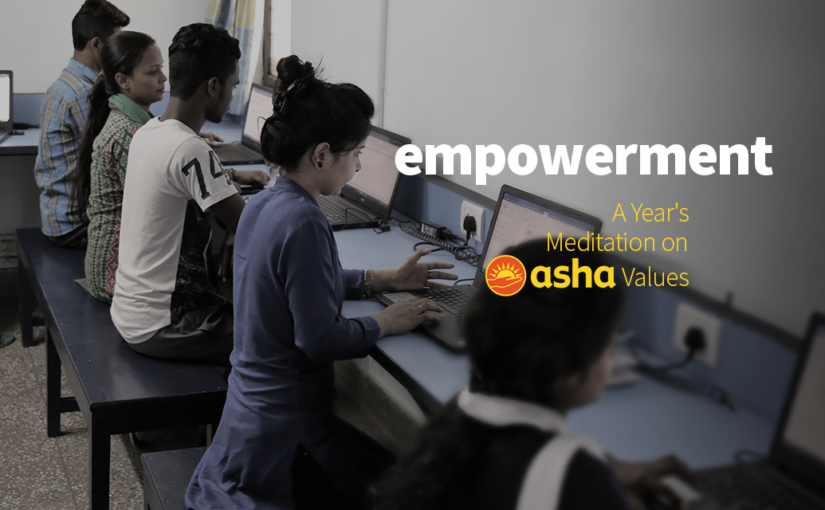
Empowerment | A Year’s Meditation on Asha Values

by Steve Watson

In February, I spent time as a pastor with two people who seemed to have very little power. One was an inmate in the custody of ICE, waiting for months to see whether or not he’d be deported. He is living under armed guard in a prison with no real say or insight into anything about his future. The other was a poor mother raising her family in a done-room home nestled against a busy freight line in the slums of Delhi, India. Both were poor, in many ways trapped by circumstance and discarded by society, and both seemed in many ways powerless.

These visits stirred many things in my mind and spirit, as you can imagine, and have evoked much prayer, further advocacy, and many thoughts. But one thing I noticed is that each of these individuals still had tremendous power they were exercising in the world. They had the power to keep surviving, to do the next thing that will make their or their children’s lives more likely to flourish tomorrow. They had power they were exercising over their hearts and mindset, whether they would live in despair, or as one put it, “with hate and anger in my heart,” or with hope. Both individuals moved me to see that to be alive is always to have power.

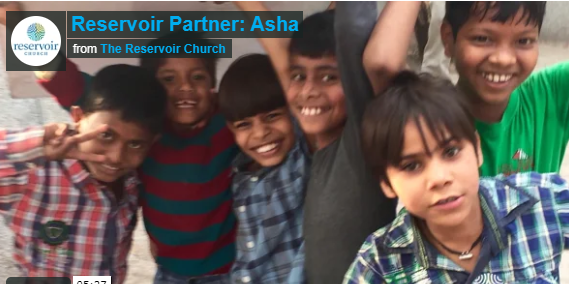
Over the past three years, one of the most powerful forces of inspiration in my life has been the work of an Indian NGO called Asha. Over thirty years ago, my friend Dr. Kiran Martin, recently graduated from medical school in Delhi, heard of a cholera epidemic in her city’s slum communities. It was devastating, but not unusual news, emanating from the poorest, least privileged corners of her city. But rather than saying a prayer, sending a check, or doing nothing, Dr. Martin set up a small cholera clinic in one slum neighborhood. As she stayed, she continued to take step after step to serve and empower her new friends. The work expanded beyond health clinics to public health, women’s and children’s empowerment, economic development, and higher education access. Asha is now transforming the lives of over 700,000 residents of nearly one hundred slum communities in around Delhi.

Through my family’s and my church’s partnership with Asha’s US-based advocacy organization, I have seen first hand the amazing results of Asha’s work and the deep interpersonal and spiritual values by which it is conducted. More than anyone else right now, Asha is pushing me (I hope!) to be a better human being – less focused on consumption and material wealth, and more on relational and spiritual wealth.

In 2019, I am letting Asha’s values guide my daily meditation and prayers. Each month, I meditate daily on one of Asha’s ten values. Today I share a few reflections on the second, my February’s reflection on empowerment.

Asha defines empowerment as “the capacity of individuals or groups to make choices and to transform those choices into desire actions and outcomes. Empowerment enables the true potential of every individual to be unleashed for the benefit of communities and our world.”

As I meditated each day in February on empowerment, two things struck me again again – one is that we are never 100% stuck. We all, myself included, always have power. We have choices. Time and again in February, I noticed ways I would normally feel constrained or trapped by my constraints or circumstances, in ways small or large. Unlike my friend in custody, I do not live behind bars. And unlike the woman I met in Delhi’s slums, I do not face the oppressive limitations of severe poverty. To compare my tendency to feel or act unempowered with their circumstances would be to trivialize their suffering. And yet, even in my privileged, empowered life, I shrink back from offering myself for others good so much. I don’t follow through on choices I could make which would lead to good outcomes for myself, my family, and the world. This month, I noticed this more, and prayed that God will help be empowered, would give me the power to offer all I am and have for the benefit of communities and our world.

This Lent, my friend and colleague wrote a blog about prayer and agency. In it, he acknowledged that unhealthy communities and systems, and sometimes especially unhealthy religious communities strip us of agency. They can teach us not to trust our will or voices, develop fear of our own agency in the world. While our own desires aren’t always healthy or ideal, they’re worth noticing and cultivating. And while our choices can be destructive or wasteful, not always healthy and helpful, the problem isn’t our power or agency – it’s that power not guided toward our own or anyone else’s flourishing.

The second thing that struck me is how beautiful it is to empower others. Whether as a boss or a coworker or a parent, there are small risks I experience when empowering someone else. What if I don’t like the choices they make or the way they do something that I might have done myself? What if I give away influence or attention that I want to keep? My desire to hold power and attention is painful for me to see in myself or admit, but I feel it sometimes.

And yet, each time last month I made an active choice to empower someone I live or work with, I was glad I did it, whether or not I enjoyed the exact choices the other person made with their power. To see others around me have their potential unleashed for the benefit of communities and our world is to see their joy and flourishing and to see the world receive gifts from their voice and leadership and experience that no one else had available to give.

Here’s to a life of cultivating our own power and voice, for the flourishing of communities and the world. And here’s to a life of empowering others, particularly when we’ve had privilege and attention plenty in our lives, and watching new voices and new leaders work wonders among us!